The Future of EMS: Why Circular Design is the Next Great Marketing and Strategy Frontier in EMS
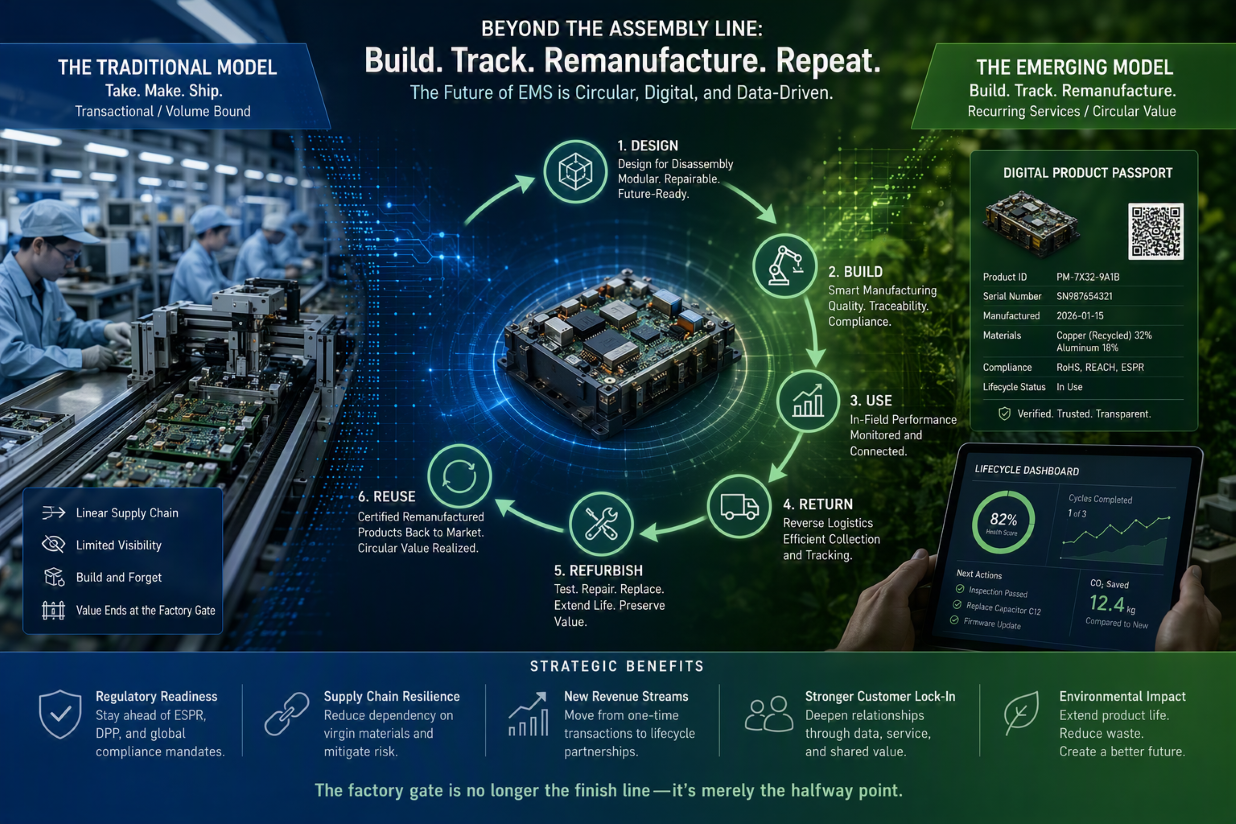
For decades, the Electronics Manufacturing Services (EMS) industry has operated on a beautifully optimized, stubbornly linear promise: You design it, we source it, we build it, and we ship it. Success was measured at the factory gate. Once a product cleared inspection and loaded onto a pallet, our job was effectively done.
Today, that traditional "build-and-forget" model is shifting.
Between volatile global resource scarcities, intense geopolitical competition over critical inputs, and sweeping regulatory waves like Europe’s Ecodesign for Sustainable Products Regulation (ESPR), the boundaries of manufacturing are expanding. With the phased rollout of mandatory Digital Product Passports (DPPs), a product’s lifecycle data must now be as transparent and structured as its physical build.
For EMS leaders, a shift from compliance headache or an operations challenge to a massive strategy and marketing opportunity is happening.
The providers who win the next decade will be those who stop viewing circularity as a downstream recycling problem and start selling it as an upstream design-and-data capability.
The Current Situation: The Transparency Squeeze
Right now, original equipment manufacturers (OEMs) are caught in a tight squeeze. Their consumers demand sustainable products, their investors demand robust ESG metrics, and international regulators are demanding machine-readable, unit-level traceability.
But OEMs don't actually build the products; we do. They don't manage the deep, multi-tiered component supply chains; we do.
This creates an information and capability asymmetry. An OEM cannot easily track the material truth of a complex PCB assembly—the exact percentage of recycled copper, the origin of a power module, or the hazardous substance declarations—without their EMS partner.
The Shift: Circularity has officially graduated from a corporate social responsibility (CSR) footnote to a core geoeconomic and industrial strategy.
The Core Challenge: The Friction of the Permanent
The physical barrier to a circular electronics economy has always been how we build. Traditional high-reliability manufacturing prioritizes permanence: heavy potting compounds, permanent structural adhesives, and complex material composites designed to withstand harsh environments.
While excellent for durability, this makes disassembly, refurbishment, or localized repair economically unviable. If it takes a technician 45 minutes of manual labor to open, desolder, and harvest a single high-value component from a returned automotive or medical module, the financial math of circularity falls apart.
Furthermore, data friction is just as high. Supply chain data is too often trapped in static PDFs or siloed supplier portals. When a product reaches its end-of-life, the recycler or remanufacturer has no idea what "material truth" is inside the housing, leading to downcycling or the landfill.
The Opportunity: Re-engineering the Value Proposition
This is exactly where strategic marketing meets operational excellence. EMS providers who proactively invest in Design for Disassembly (DfD) and structured data infrastructure can fundamentally reposition their market value.
Instead of competing strictly on manufacturing cost-per-minute, an agile EMS provider can pitch a dual value proposition to Tier 1 clients:
Engineering-as-a-Service (EaaS): Collaborating during the New Product Introduction (NPI) phase to introduce modular subassemblies, smart fastening mechanisms, and easily separable material paths. We can design products that are robust during use, yet elegant to take apart.
Data-as-a-Service (DaaS): Acting as the orchestrator of the Digital Product Passport. Because the EMS provider sits at the nexus of procurement and assembly, we are uniquely positioned to aggregate, structure (using semantic web standards like JSON-LD), and host the lifecycle data that regulators and customs agents now demand.
Future Scenarios: Transforming the Business Model
As these capabilities mature, the ultimate horizon is the evolution of the EMS business model itself. We will likely see a shift from transaction-based volume manufacturing to long-term lifecycle partnerships.
Imagine a future where an EMS provider, after building a module once, through smart asset tracking and modular design, receives the unit back after its first lifecycle, tests it via virtual metrology, replaces only the degraded components, re-flashes the Digital Product Passport, and sends it back into the market as a certified remanufactured asset.
This completely alters the margin profile of contract manufacturing. It mitigates the risk of virgin raw material shortages, builds immense supply chain resilience against external macro shocks, and locks in deep, multi-year customer relationships that are incredibly insulated from competitors.
The Strategic Takeaway
Circularity is evolving from doing "less bad” to “doing business differently”.
For marketing and strategy leaders in the electronics space, the directive is clear: move from selling just capacity and quality to traceability, modularity, and resource security.
The future of EMS will be a circle and not a straight line.
Author(s):
-
 Sherwin Nones (Marketing Director)