Why ISO/IEC 17025 Accreditation Matters for Testing and Calibration Laboratories

Key Takeaways
- ISO/IEC 17025 is an international standard that specifies the competence of testing and calibration laboratories.
- Accreditation indicates technical competence, quality management, and trustworthy testing procedures.
- Accurate test results and regulatory compliance directly translate to mitigated risk and stronger market confidence.
- Choosing an ISO/IEC 17025 accredited laboratory can reduce risks, improve product quality, and strengthen customer trust.
- Global IMI's accredited lab demonstrates the value of internationally recognized standards to manufacturers for dependable analytical and calibration services.
You've planned for months, making sure your electronic component is ready to be launched. Things are looking good until a routine quality check holds a surprise in store for you. An incorrect measurement can cause production delay, increase costs, or even result in a product recall. That's why reliable laboratory testing isn't just another checkpoint; it's the foundation of confident decision-making.
Whether you're manufacturing automotive components, industrial electronics, medical devices, or consumer products, reliable testing and calibration help you make confident, informed decisions.
What Is ISO/IEC 17025?
ISO/IEC 17025 is the ISO standard for testing and calibration laboratories recognized worldwide. It sets out standards of technical competence, impartiality and uniform laboratory operations.
ISO/IEC 17025 is not a generic quality certification, it is specifically oriented to the performance of a laboratory. It ensures scientific validation of testing procedures, proper calibration of equipment, and accurate and repeatable results.
In many industries, test reports from an accredited laboratory are required before products can enter regulated markets.
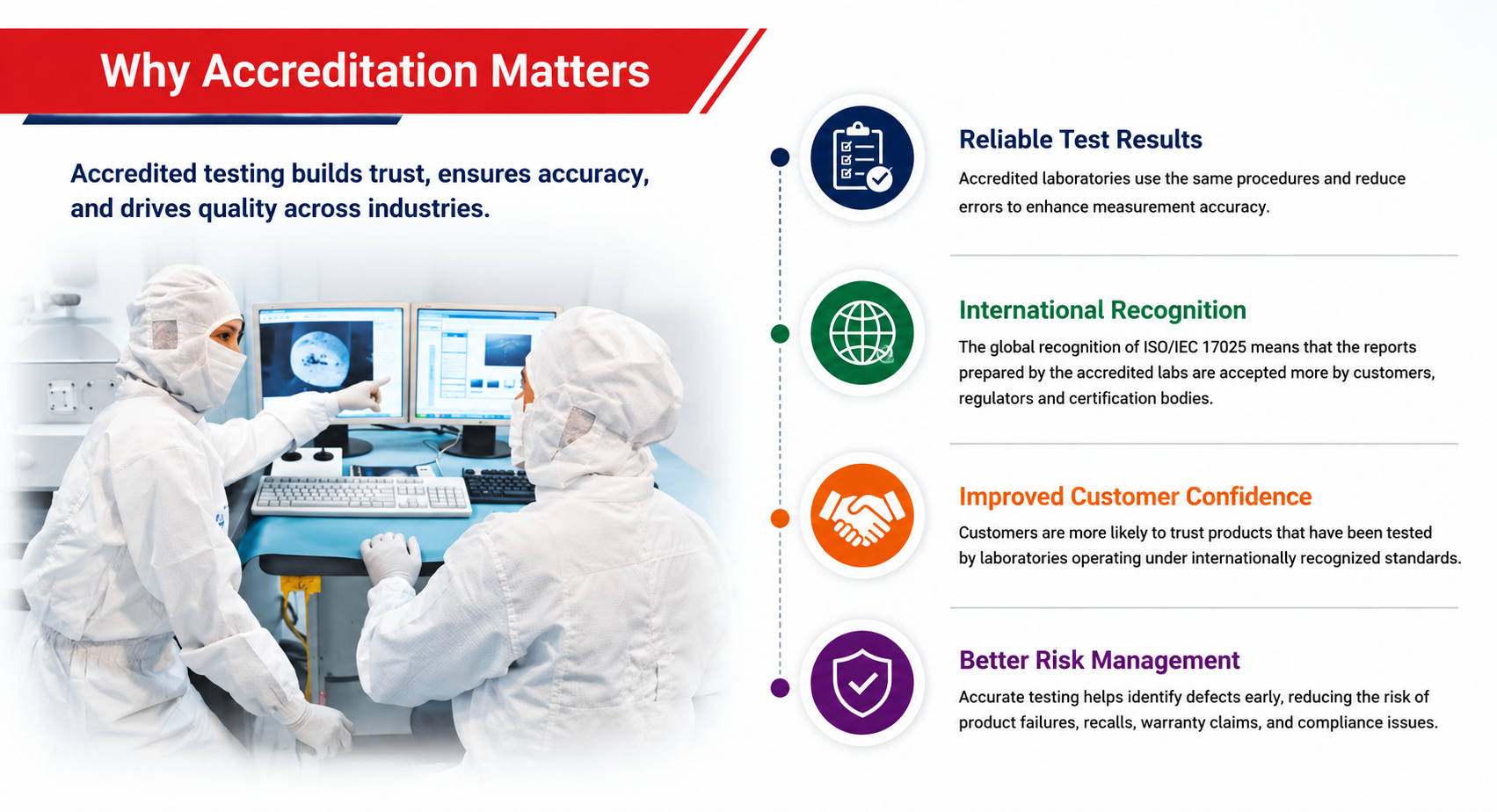
Why Accreditation Matters
Every production decision relies on data. Whether you're approving a new supplier, validating a product design, or preparing an international shipment, you're trusting laboratory results to guide the next step. When those results aren't reliable, the consequences can range from costly delays to failed audits and unhappy customers.
Supporting Product Quality Across Industries
Think about the products you use every day, a vehicle's braking system, a medical device in a hospital, or the circuit board inside a smartphone. Behind each of these products is extensive laboratory testing that verifies safety, reliability, and performance before they ever reach the market.
Testing and calibration facilities are used by a variety of industries such as:
- Automotive
- Electronics
- Aerospace
- Medical devices
- Manufacturing
- Telecommunications
- Industrial equipment
Across these industries, laboratory testing verifies product performance before products reach the market.
An experienced analytical testing laboratory uses standardized methods to evaluate materials, components, and finished products, supporting both quality assurance and regulatory compliance.
The Role of Calibration in Product Reliability
Think of using a measuring device that has minor faults in its mechanics. One wrong measurement may not seem important, but it can lead to major problems if trouble happens thousands of times in production. Laboratory equipment works the same way. Even the most advanced testing methods depend on properly calibrated instruments to produce accurate, repeatable results.
Regular calibration helps laboratories minimize measurement uncertainty, detect equipment drift before it affects results, and ensure consistent testing across different production batches.
The frequent calibration also minimizes uncertainties and facilitates consistent testing between different production lots.
Why Manufacturers Choose Accredited Laboratories
Laboratory testing means more than just compliance for manufacturers; it is an important component of an effective quality management system.
Accredited laboratories support organizations by:
- Validating product designs
- Verifying manufacturing consistency
- Supporting customer qualification requirements
- Improving supplier quality
- Reducing production risks
- Meeting international market expectations
Reliable testing data allows quicker decisions to be made and eliminates unnecessary production mistakes.
Selecting the Right Laboratory
All testing facilities are not created equal. When selecting a laboratory partner, consider the following:
- Current accreditation status
- Scope of accredited testing
- Technical expertise
- Equipment calibration practices
- Industry experience
- Reporting accuracy
- Turnaround time
There should also be a clear quality protocol in place at the analytical testing laboratory that is continually enhanced to improve testing capabilities.
Global IMI's Commitment to Accredited Testing
Global IMI demonstrates its commitment to world-class manufacturing through its Analytical Testing and Calibration (ATC) Laboratory. Global IMI received ISO/IEC 17025 accreditation from the Philippine Accreditation Bureau after a comprehensive assessment of its technical competence and laboratory quality management system.
Our laboratory continuously develops and maintains its proficiency in testing and calibration to internationally recognized standards and gives customers confidence to ensure operational excellence.
As one of the Top 30 EMS companies in the world, IMI has over 40 years of experience in providing electronics manufacturing and technology solutions.
We are ready to support your business on a global scale. Our proven technical expertise, worldwide reach, and vast experience in high-growth and emerging markets make us the ideal global manufacturing solutions partner.
Let’s work together to build our future today.
FAQs
1. What is the purpose of ISO/IEC 17025 accreditation?
Accreditation by ISO/IEC 17025 ensures that a testing or calibration laboratory is technically competent, has quality management systems in place, has qualified personnel and has validated methods and procedures to ensure the production of accurate and reliable results.
2. Why should businesses choose an ISO/IEC 17025 accredited laboratory?
Compliance with internationally recognized quality standards by accredited laboratories gives a greater level of confidence in the testing results, which helps to support regulatory compliance, minimize operational risks and build customer trust.
3. What industries benefit from analytical testing laboratories?
Laboratory testing is essential to industry for ensuring product quality, safety and performance prior to product commercialization, including in the automotive, electronics, aerospace, medical devices, manufacturing, telecommunications and industrial equipment sectors.
4. How does ISO/IEC 17025 improve product quality?
The standard stipulates that laboratories must employ validated testing methods, calibrated equipment, qualified personnel, and must have in place quality management procedures. This ensures the results of tests are consistent, accurate, reliable and dependable, resulting in improved product quality and reduced production risks.