Save the Planet, Save Money with V2G
Understanding Vehicle-to-Grid (V2G)
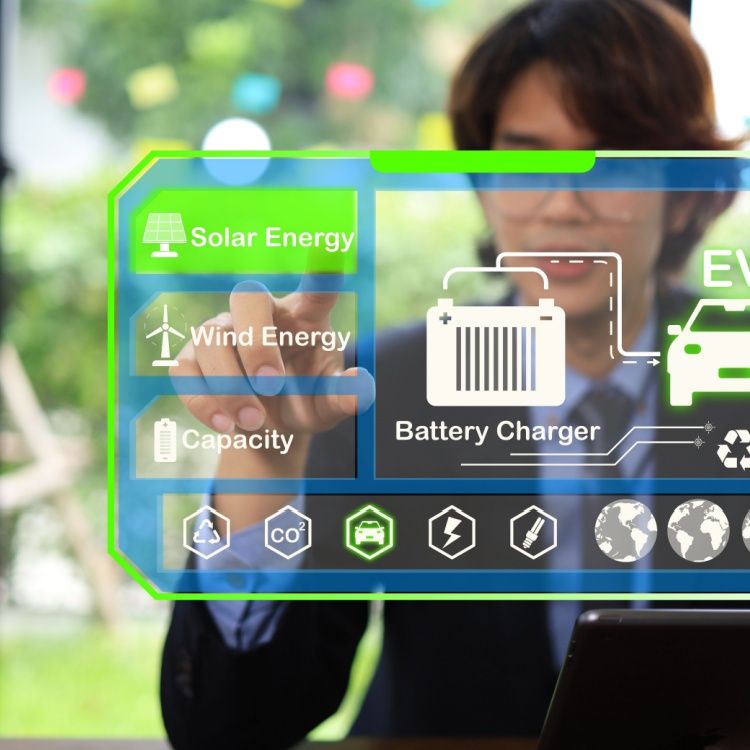
Vehicle-to-grid (V2G) technology is redefining what electric vehicles can do in a modern, future-ready energy system. Rather than functioning solely as a means of transport, EVs equipped with bidirectional charging can also serve as mobile energy assets. Through V2G, electricity stored in an EV’s battery can be sent back to the power grid when demand is high, helping stabilize supply and ease pressure during peak hours.
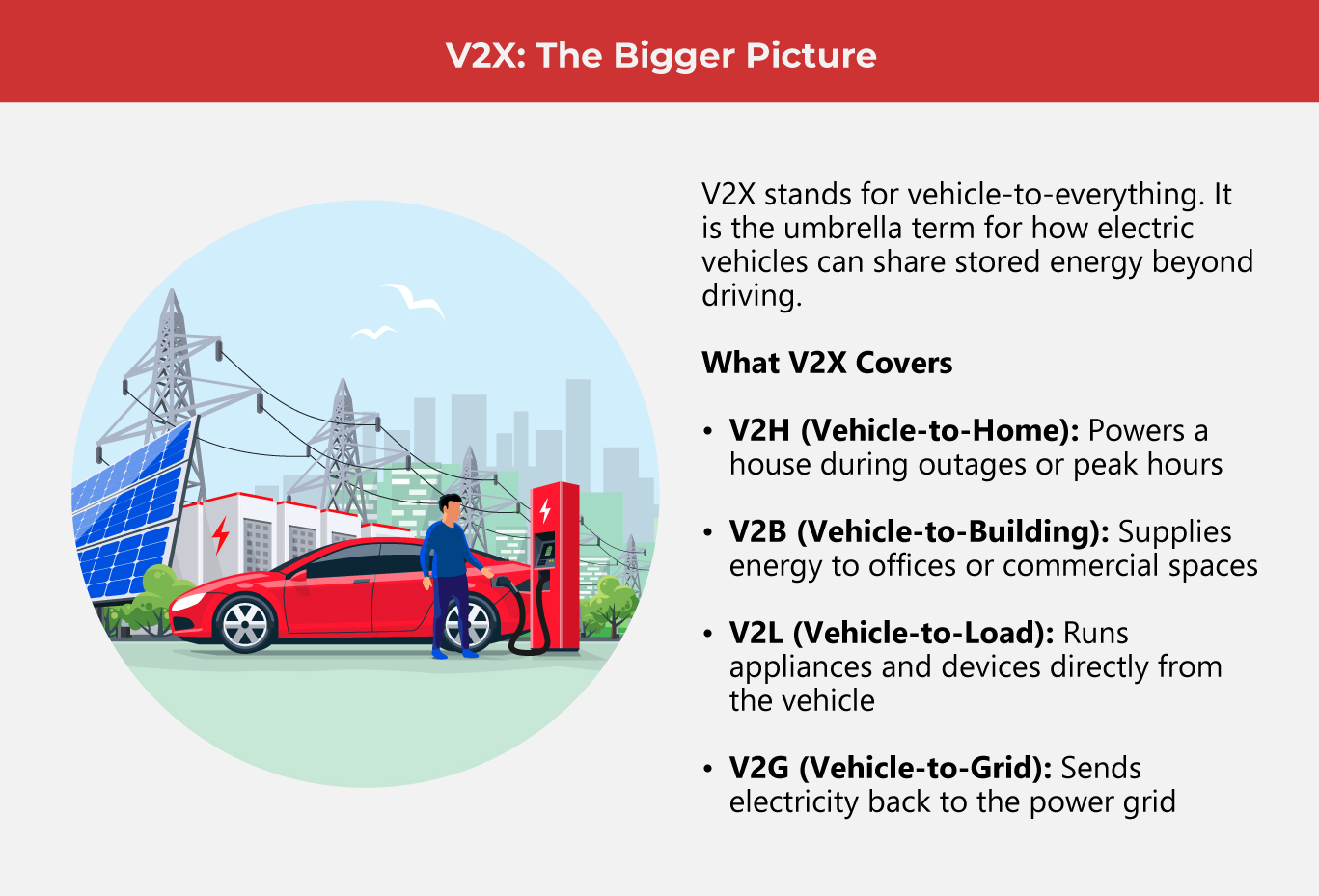
At its core, V2G creates a two-way relationship between vehicles and the grid. While conventional charging draws power from the grid into a car’s battery, bidirectional systems allow energy to flow back when needed. This capability enables EVs to support grid operations, respond to shifts in electricity demand, and absorb excess power when renewable generation, such as solar or wind, is abundant. Similar applications also allow vehicles to supply electricity to homes or buildings during outages, adding an extra layer of resilience.
As EV adoption accelerates and electricity consumption rises nationwide, V2G offers practical pathways to sustainability and efficiency. By charging during periods of lower prices or cleaner generation and discharging during peak demand, EV owners can help balance supply while potentially reducing energy costs. In this way, vehicles function as flexible storage units that support both mobility and the broader power system.
Why V2G is worth exploring
EVs, particularly high-capacity models, represent a growing opportunity in the automotive market, with the US’s 2.1 million battery EVs offering up to 126 gigawatt-hours of storage to support emergencies, peak demand, and renewable energy integration. Here’s how V2G delivers these benefits.
-
Energy efficiency
V2G supports the industrial market by turning EVs into mobile energy storage, balancing renewable supply, reducing reliance on fossil fuels, and enabling decarbonization, energy efficiency, and electrification across factories, warehouses, and large-scale operations.
-
Boosted economic value
EV batteries provide cost-efficient energy storage, and with V2G, efficiency can increase up to 10 times. By 2030, 250 million EVs could serve as mobile storage alongside stationary solutions, supporting advanced manufacturing solutions.
-
Convenience
V2G and smart energy management let EVs charge anywhere, regardless of location or infrastructure. These features maximize the use of existing batteries and support scalable manufacturing solutions for the growing EV market.
-
Grid stabilization
Smartly controlled EVs can feed electricity back to the grid during peak hours, easing congestion and reducing reliance on expensive reserve power plants. This approach helps improve operational efficiency while supporting grid stability.
-
Additional income
Fleet operators can earn additional income by using EVs as mobile energy storage, discharging batteries to support the grid. This approach helps businesses manage power needs efficiently while offering innovative industrial solutions.
(Also read: Safer, Greener EV Batteries in South Korea)
How V2G technology works
To participate in V2G systems, a few essentials are needed: a smart meter at home, a compatible bi-directional charger, an electric vehicle, and an energy supplier offering a suitable home charging tariff. Once set up, the charger communicates with both the car and smart meter, using intelligent software to create a controlled energy pathway between the vehicle and the electricity grid. Homeowners can then manage how much electricity is transferred and when, giving them control over their energy usage.
There are, however, limits to V2G charging. In the UK, electricity connections usually cap daily transfers between 3.68 kilowatts (kW) and 7.36 kW. Additional restrictions may include daily or yearly time limits to prevent grid overload. Upgrades to a home’s electricity equipment or connection to the grid may also be required. Those already exporting energy from other sources, such as solar panels, may face further restrictions.
As V2G adoption grows, decision makers may impose stricter limits to safeguard the grid. The expansion of this technology highlights opportunities for innovation in manufacturing technologies and industries, particularly in developing smarter bi-directional chargers and advanced EV systems. By integrating these solutions, both homes and industrial sectors can better manage energy flows while supporting grid stability and sustainable practices.
(Also read: The State of Our EV Nation)
Hurdles to V2G integration
Despite its potential, several technical, regulatory, and practical obstacles are slowing the widespread adoption of V2G.
-
High costs
The high cost of V2G chargers, ranging from £3,000 to £6,000 ($4,100 to $8,200), remains a barrier. As global manufacturing scales, prices may fall, but potential earnings from using the technology could also decrease.
-
Limited two-way charging
The majority of EVs currently in use rely on unidirectional chargers, allowing them to draw power from the grid but not return energy to it. Some automakers have started offering bidirectional chargers, but their high cost has kept adoption levels limited.
-
Cybersecurity risks
The growing interconnected network of EVs and grids raises cybersecurity concerns, from potential power cuts to data breaches. Utilities face challenges sharing data with third parties, highlighting the need for robust reliability testing.
-
Lack of standardization
Widespread adoption of two-way charging depends on standardized communication, affordable chargers, and smart grids. The current lack of clear tariffs, regulations, and charger interoperability poses challenges for regulators and slows seamless integration of V2G systems.
-
Battery wear
Concerns exist that V2G may accelerate battery wear, but research shows most batteries outlast their vehicles. Smart management software can control discharge cycles, helping maintain performance and optimize the EV’s overall product life profile.
-
Structural constraints
Many older US power grids are ill-equipped for the two-way energy flows V2G requires, meaning significant and expensive infrastructure upgrades are necessary to enable integration.
Making V2G mainstream
For V2G to become mainstream, widespread adoption of compatible hardware and vehicles is essential, alongside closer collaboration between automakers and the energy sector.
Several V2G chargers are already available, typically offering 11 kW for home or workplace use, with some models reaching 15 kW. Most are DC chargers, which bypass the vehicle’s unidirectional onboard charger, although a few AC solutions are being tested. As the technology matures, charging capacities and device designs are expected to expand further.
On the vehicle front, models like the Nissan Leaf, Kia EV9, and Mitsubishi Outlander PHEV currently support bidirectional charging, while others, such as Volkswagen ID.4, Polestar 3, and Hyundai IONIQ 5, are undergoing compatibility tests. Some vehicles, like the Nissan Ariya, aim to reduce costs through onboard DC chargers.
Collaboration between OEMs and energy providers is crucial. By showcasing pilot programs, educating customers on cost savings, and offering incentives for early adoption, the industry can encourage participation while strengthening grid resilience. Engineering capabilities will play a key role in scaling and optimizing these systems efficiently.
As one of the Top 20 EMS companies in the world, IMI has over 40 years of experience in providing electronics manufacturing and technology solutions.
We are ready to support your business on a global scale.
Our proven technical expertise, worldwide reach, and vast experience in high-growth and emerging markets make us the ideal global manufacturing solutions partner.
Let's work together to build our future today.
Other Blog