The New Life of EV Batteries
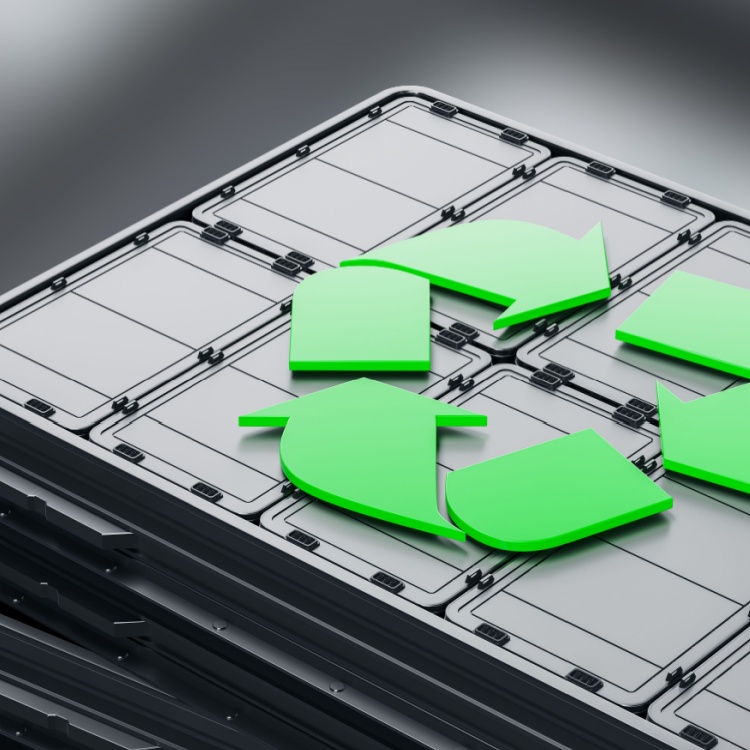
The EV battery circular economy is reshaping the automotive market by turning used batteries into valuable resources through recycling and reuse. This shift supports more efficient material recovery and improves resource management across the growing EV sector.
The market has expanded rapidly, rising from $3.82 billion in 2025 to a projected $4.88 billion in 2026, reflecting a 27.7% CAGR. Growth is being driven by accelerating EV adoption, the commercialization of lithium-ion batteries, early-stage recycling regulations, and increasing volumes of battery waste. At the same time, advances in material composition analysis are improving recovery efficiency and supporting more precise extraction of valuable components.
Advanced recycling technologies now allow manufacturers to recover as much as 95% of critical metals, including lithium, cobalt, and nickel, significantly cutting the environmental footprint tied to conventional mining. With most EV batteries lasting around 10 to 15 years, the industry is nearing a key inflection point as the first major wave of batteries reaches end-of-life and enters recycling systems at scale.
(Also read: The Importance of EMS in Boosting EVs)
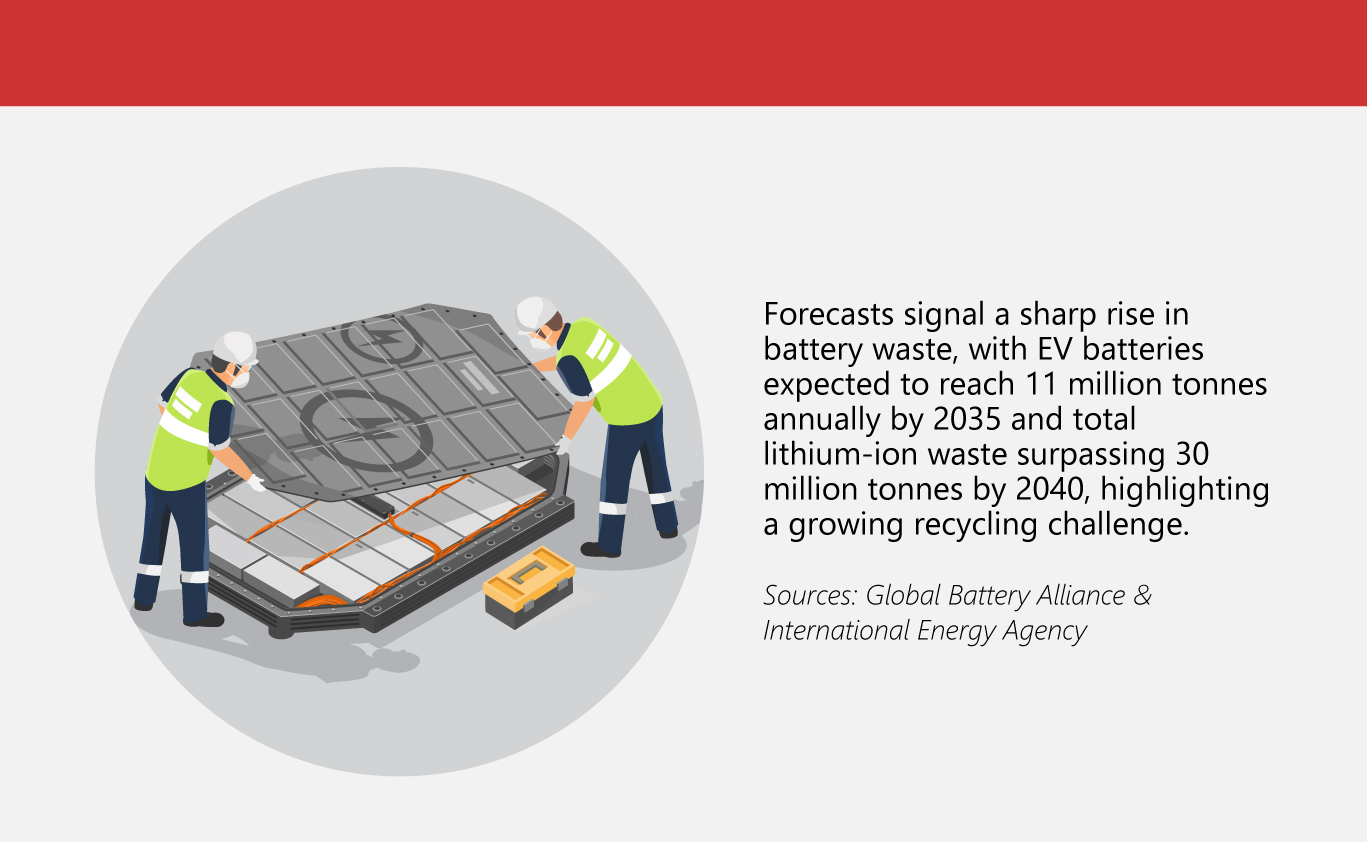
EV batteries often remain functional even after their capacity drops below 70 to 80%, although reduced range limits their suitability for long-distance use. In this stage of their product life profile, replacement decisions typically depend on whether remaining performance still meets user needs rather than complete failure.
Within the broader renewable energy market, these end-of-life batteries are increasingly repurposed for stationary storage, where residual capacity can be used to buffer intermittent solar and wind generation. They also play a growing role in grid stability, discharging stored energy during peak demand and providing emergency backup for critical infrastructure such as hospitals and data centers.
Beyond energy systems, second-life batteries are finding practical applications in low-speed electric vehicles and industrial equipment, including forklifts and golf carts. Modular reuse also supports portable power solutions for construction sites and outdoor operations, extending their operational and economic value.
When reuse is no longer viable, recycling through pyrometallurgical and hydrometallurgical processes recovers key materials for reintegration into new battery production. This circular approach reduces reliance on virgin resources and improves overall environmental performance indicators while lowering system-wide impact.
Key Players Shaping the EV Battery Circular Economy
These are some companies driving the EV battery circular economy, positioning themselves as future-ready leaders across the value chain.
-
Moment Energy
Vancouver-based Moment Energy is set to launch a battery repurposing facility, which it says will become the world’s largest of its kind. Backed by over US$100 million after a $40 million Series B round, the plant will integrate testing, processing, and deployment of second-life EV batteries, targeting 1 gigawatt-hour (GWh) capacity by 2030 and creating about 100 jobs.
-
Redwood Materials
Founded in 2017 and employing about 1,600 people, Nevada-based Redwood Materials has emerged as a major force in the EV circular economy. The company recovers over 80% of lithium and up to 95% of critical metals, processing more than 20 GWh of batteries annually and advancing a closed-loop supply chain for reuse in new production.
-
Umicore NV
Umicore plays a central role in the EV circular economy, using its proprietary pyro-hydro recycling system to recover over 95% of critical battery metals. With a 7,000-tonne facility operating and a larger 150,000-tonne European plant planned by 2026, it strengthens operational efficiency through safe dismantling and closed-loop processing that returns materials to new battery production, reducing reliance on virgin mining.
-
SK tes
SK tes, formerly TES-AMM, delivers global industrial solutions for sustainable technology lifecycle management, with a strong focus on EV battery recovery. Operating across 23 countries, it applies advanced processing methods to reclaim up to 90% of lithium, cobalt, and other key materials. Its expanding footprint in China, the Netherlands, and other regions supports circular systems by transforming end-of-life batteries into usable inputs for new production.
-
Cirba Solutions
Cirba Solutions combines advanced engineering capabilities with over 30 years of industry expertise to support EV battery recycling and material recovery. Established in 2022 through a merger, it now operates seven North American facilities processing multiple battery chemistries. The company extracts battery metals, returning them to the supply chain while expanding through partnerships and supportive policy frameworks.
(Also read: A Key Breakthrough in EV Tech)
Latest Trends in EV Battery Recycling
A range of firms are actively contributing to the EV battery circular economy, strengthening their roles across different stages of the value chain.
-
End-to-end battery recycling systems
A closed-loop system recovers materials from end-of-life batteries and feeds them back into new production, cutting dependence on fresh mining and limiting disposal impacts. Recent studies are refining these networks using tools like mixed-integer linear programming and pinch analysis to guide cost-effective investments that lower overall carbon emissions.
-
AI-assisted battery disassembly
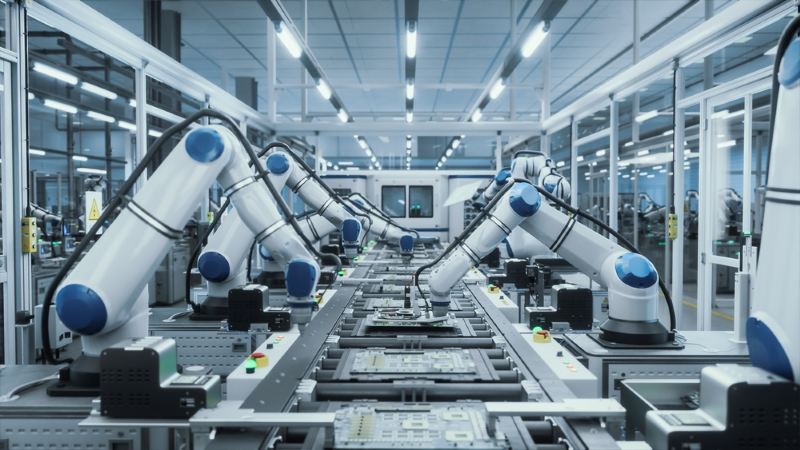
AI-powered robotic disassembly uses intelligent automation to safely and efficiently take apart complex products like EV batteries. By combining machine learning with precision robotics, systems can identify components, adapt to variations, and improve recovery rates. This reduces labor risks while supporting more efficient material recycling processes.
-
Extraction of critical minerals
Rising demand for cobalt and lithium has intensified global focus on recovering these metals from battery waste, particularly black mass. One emerging approach is bioleaching, which uses microorganisms like bacteria and fungi to extract metals from solid residues, offering a cleaner, more sustainable alternative to traditional chemical leaching methods.
-
Galvanic corrosion recovery
Researchers at the Korea Institute of Energy Research (KIER) have developed a method that leverages galvanic corrosion to restore spent battery cathodes to full performance. Operating under ambient temperature and pressure, the process enables near-complete recovery of electrochemical capacity, offering a simpler and more energy-efficient route for battery material regeneration.
-
Rising use of hydrometallurgy
Conventional pyrometallurgical smelting can handle battery waste but is energy-intensive and struggles to efficiently capture lithium. In contrast, hydrometallurgy relies on aqueous chemical processes to extract metals, delivering higher-purity outputs while using less energy, which is driving its growing preference in battery material recovery.
Closing the Loop in EV Battery Value Chains
The EV battery circular economy is steadily moving from concept to large-scale reality as recycling, reuse, and advanced recovery technologies converge. With rising battery volumes, stronger regulations, and rapid innovation in material processing, the sector is becoming central to clean mobility and resource security. From second-life applications to high-efficiency metal recovery, these developments are reshaping how value is extracted and retained, supporting a more resilient, low-carbon energy and automotive ecosystem. As one of the Top 30 EMS companies in the world, IMI has over 40 years of experience in providing electronics manufacturing and technology solutions.
We are ready to support your business on a global scale.
Our proven technical expertise, worldwide reach, and vast experience in high-growth and emerging markets make us the ideal global manufacturing solutions partner.
Let's work together to build our future today.
Other Blog