PH Manufacturing 2026 Progress, Challenges & Promise

Philippine industrial manufacturing sent mixed signals in October as factory conditions showed tentative stabilization, but demand remained under pressure, according to financial market intelligence provider S&P Global and local economists.
S&P Global reported that production slowed due to weaker demand, disruptions from unfavorable weather, and the phasing out of some product lines. Although production was still shrinking, the rate of decline moderated, pointing to early signs of leveling out. Manufacturers continued to expand their workforce, recording the fastest pace of job creation in three months, while easing workloads enabled companies to further reduce backlogs.
Operational challenges also persisted. The survey highlighted that last-minute order cancellations caused modest increases in both raw material and finished goods inventories, while companies reduced purchasing amid declining new orders. Input delivery times lengthened for a third month, reflecting lingering supply frictions even as buying volumes slowed.
Cost pressures remained contained, with input price inflation easing to a three-month low. In response to subdued demand, many producers resorted to offering discounts to protect volumes and preserve economic value through tighter supply chain management across their operations.
However, manufacturers reported improved confidence about output prospects over the coming year, supported by expectations of firmer demand. S&P Global economists cautioned, however, that the sector has remained in a sluggish phase through much of the second half of 2025, making recovery dependent on stronger consumer spending. Michael Ricafort, chief economist at Rizal Commercial Banking Corporation (RCB), also said the slight PMI improvement was partly driven by improved weather conditions, underlining the uneven nature of the rebound.
(Also read: How to Keep Your Manufacturing Compliance Top Tier)
Manufacturing rebounds in December 2025
A long-awaited spark lit up the manufacturing sector in December, as factory activity climbed back into growth territory after months of contraction, driven by a rebound in new orders that hinted at a possible turning point.
The latest purchasing managers’ index rose to 50.2, marking the strongest reading since August and a break from four straight months of contraction.
The rebound was led by a recovery in new orders, which encouraged firms to restart purchasing after a period of cutbacks. As input buying resumed, inventory levels stabilized. Stocks of materials stopped falling, while finished goods inventories rose as companies positioned themselves for potential demand in the months ahead.
Despite the improvement in orders, production volumes continued to decline. Export demand remained a major weakness, with overseas orders dropping at their sharpest pace in more than a year and dragging on overall sales. Employment levels also fell for a fourth consecutive month, although the pace of job losses eased, hinting at some stabilization in manufacturing careers and broader labor conditions.
Economists cautioned that the recovery remains fragile. Analysts at S&P Global noted that the manufacturing sector is still facing strong headwinds from weak external markets, leaving domestic demand as the main driver of growth.
Ateneo de Manila University economist Leonardo Lanzona said the December uptick may partly reflect seasonal factors such as holiday spending and remittance inflows, warning that sustained momentum will require deeper structural shifts toward higher-value, greener, and more digitally integrated manufacturing solutions.
(Also read: Improve Your Supply Chain with AI)
PH as a high-value manufacturing hub
As companies reconfigure networks to reduce risk and improve resilience, the Philippines is drawing growing attention as a destination for higher-value production. A key signal of this shift is Samsung’s reported plan to invest about US$1 billion in a new facility in the country, a move that highlights Manila’s rising profile in a region competing to host future-ready industrial platforms.
While Samsung has yet to outline the scope of the project, analysts believe the facility could support semiconductor assembly, electronics manufacturing, or advanced component production. These activities align with the country’s expanding base of technical talent and its established role in electronics exports. The project is also expected to introduce advanced manufacturing technologies and operational systems that could lift overall industry standards.
Beyond the factory floor, the investment would likely include workforce training, digital systems, and possibly research functions, helping modernize local manufacturing industries and deepen the country’s position in regional value chains. The economic ripple effects could be significant, ranging from new high-quality jobs to stronger participation of local suppliers in multinational procurement networks.
If the project moves forward, it would mark a milestone in the Philippines’ push to become a more integral player in global manufacturing. More importantly, it could catalyze other multinational firms to consider the country not just as a low-cost base, but as a competitive, future-ready hub for sophisticated production.
What’s fueling PH manufacturing?
Growing opportunities and strategic strengths are positioning the Philippines as a top choice for manufacturing investment.
-
Affordable & skilled labor
Labor costs in the Philippines remain highly competitive, backed by a workforce that is young, flexible, and proficient in English. This combination equips businesses with capable talent to drive both domestic and international manufacturing operations.
-
Supportive policy
The government’s CREATE MORE Act provides focused tax incentives and simplified regulatory procedures for priority sectors, encouraging investment, boosting industrial competitiveness, and supporting the growth of premium manufacturing industries.
-
Lower export reliance
The Philippines’ comparatively lower reliance on external markets for economic growth, relative to regional peers, provides the domestic economy with greater resilience, cushioning against global shocks while supporting steady internal demand and sustainable development.
-
BSP rate reductions
The BSP’s key rates have been cut by a total of 100 basis points in 2025, providing a boost to the manufacturing sector by lowering borrowing costs, improving cash flow, and supporting investment in production and operations.
-
Infrastructure upgrades
Upgrades in infrastructure, spanning logistics networks to energy systems, are easing operational bottlenecks for manufacturers. Combined with the Philippines’ strategic ASEAN location, businesses gain easier access to regional trade agreements and key markets across Asia and beyond.
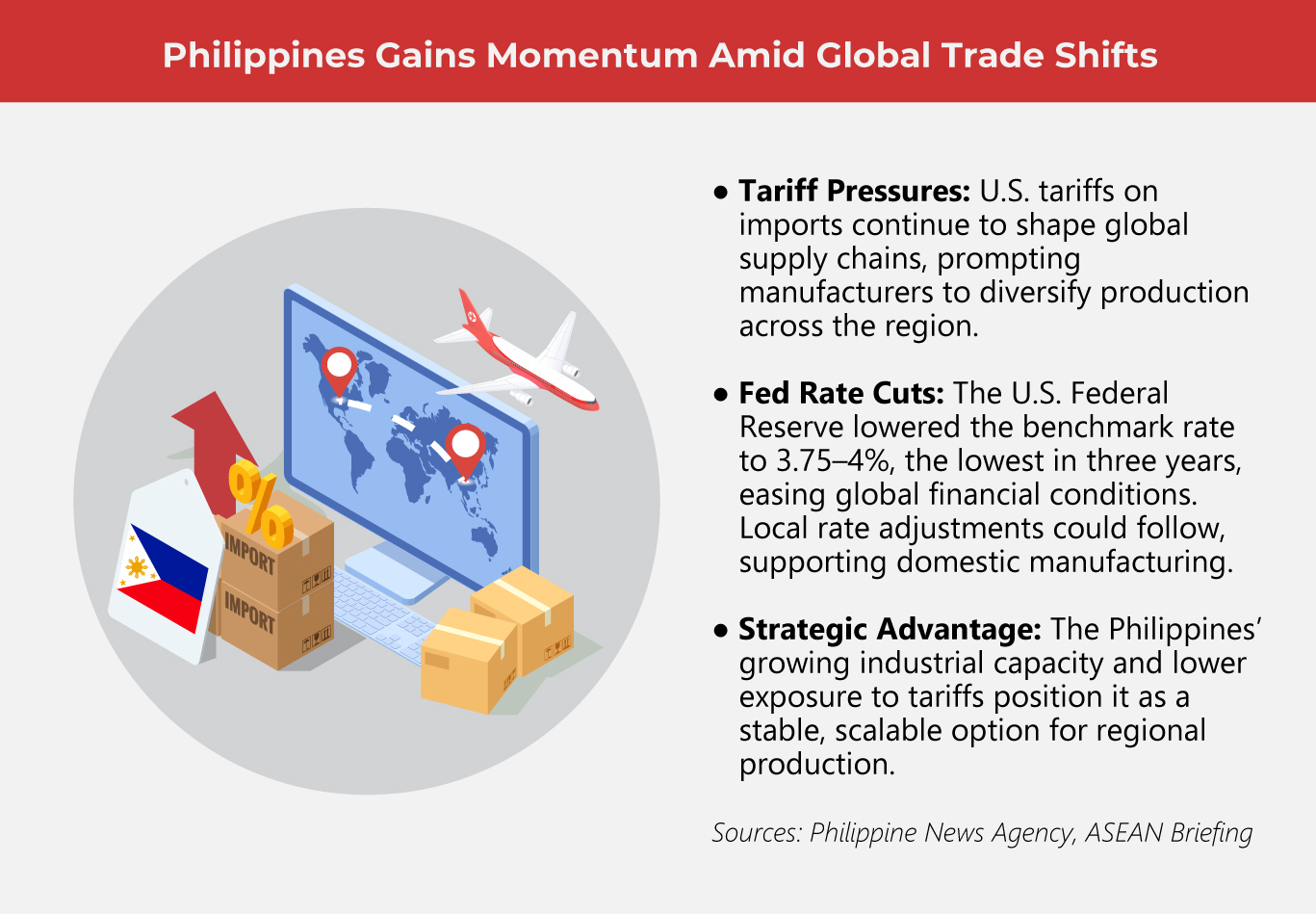 As global manufacturers rethink supply chains, the Philippines’ expanding industrial base, strategic location, and growing appeal beyond traditional export hubs suggest it could play a larger role in the international scene.
To capitalize on this momentum, stakeholders must address infrastructure and value‑chain gaps. Success will depend on sustaining investor confidence and nurturing capabilities that position local industries for long‑term competitiveness in manufacturing excellence.
As one of the Top 20 EMS companies in the world, IMI has over 40 years of experience in providing electronics manufacturing and technology solutions.
We are ready to support your business on a global scale.
Our proven technical expertise, worldwide reach, and vast experience in high-growth and emerging markets make us the ideal global manufacturing solutions partner.
Let's work together to build our future today.
Other Blog