6 Steps to Successful New Product Introduction

Bringing a new product to market is rarely straightforward, often involving shifting requirements, coordination challenges, and unexpected risks. A structured approach to team alignment is essential to manage this complexity effectively. The NPI process helps guide cross-functional teams through each stage, ensuring smoother transitions and clearer communication as ideas move from concept toward launch.
Within product development, NPI strengthens both product design and downstream execution by improving operational efficiency and enhancing manufacturing capabilities. Each phase focuses on refining the design, validating performance, optimizing manufacturability, and ensuring compliance with regulatory standards. While closely connected to new product development (NPD), NPI extends further by covering the critical steps required to successfully bring a finished product into full market production.
(Also read: Why You Should Prioritize Multi-Sourcing in 2026)
6 Key Phases of NPI
A disciplined development approach helps ensure reliable quality, consistent output, and faster execution across intricate global manufacturing supply chains.
-
Concept development & viability analysis
This phase converts opportunities into validated concepts through research, customer insight, and feasibility analysis. Teams assess competition, refine ideas, and build a business case with return on investment (ROI) and risk. Early validation is critical to focus investment on concepts with real economic value.
-
Product design & development
Ideas take shape through design and engineering as concepts evolve into detailed, testable solutions. Teams build computer-aided design (CAD) models, run simulations, prototype rapidly, and select materials that balance cost and performance. Collaboration ensures manufacturability, while digital tools accelerate iteration and prevent costly redesign.
-
Iterative prototyping & validation
Prototypes move into rigorous product validation to confirm safety, compliance, and performance expectations. Functional checks, environmental trials, and stress-based reliability test scenarios reveal how the product behaves under real-world conditions. Iterative refinements follow, while manufacturing methods are assessed to support scalable and consistent production readiness.
-
Pilot manufacturing & process verification
A controlled pilot phase bridges design and full-scale output, allowing teams to test workflows, refine tooling, and stabilize supply chains before ramp-up. Standard operating procedures are established to ensure consistency, while suppliers and materials are validated for reliability.
-
Product release
Following bridge production, the product enters full-scale manufacturing and reaches the market through coordinated rollout efforts. Output is scaled while maintaining strict quality controls, supported by aligned logistics, sales, and marketing execution. Continuous monitoring of early performance ensures rapid adjustments and long-term manufacturing excellence.
-
Post-market assessment
Teams focus on continuous improvement by reviewing customer feedback and sales performance to uncover areas for enhancement. These insights are fed into subsequent development cycles, strengthening innovation over time. This feedback loop helps ensure products remain future-ready, sustaining long-term competitive advantage.
(Also read: Digital Twins: Boosting Efficiency, Speed, and Profits)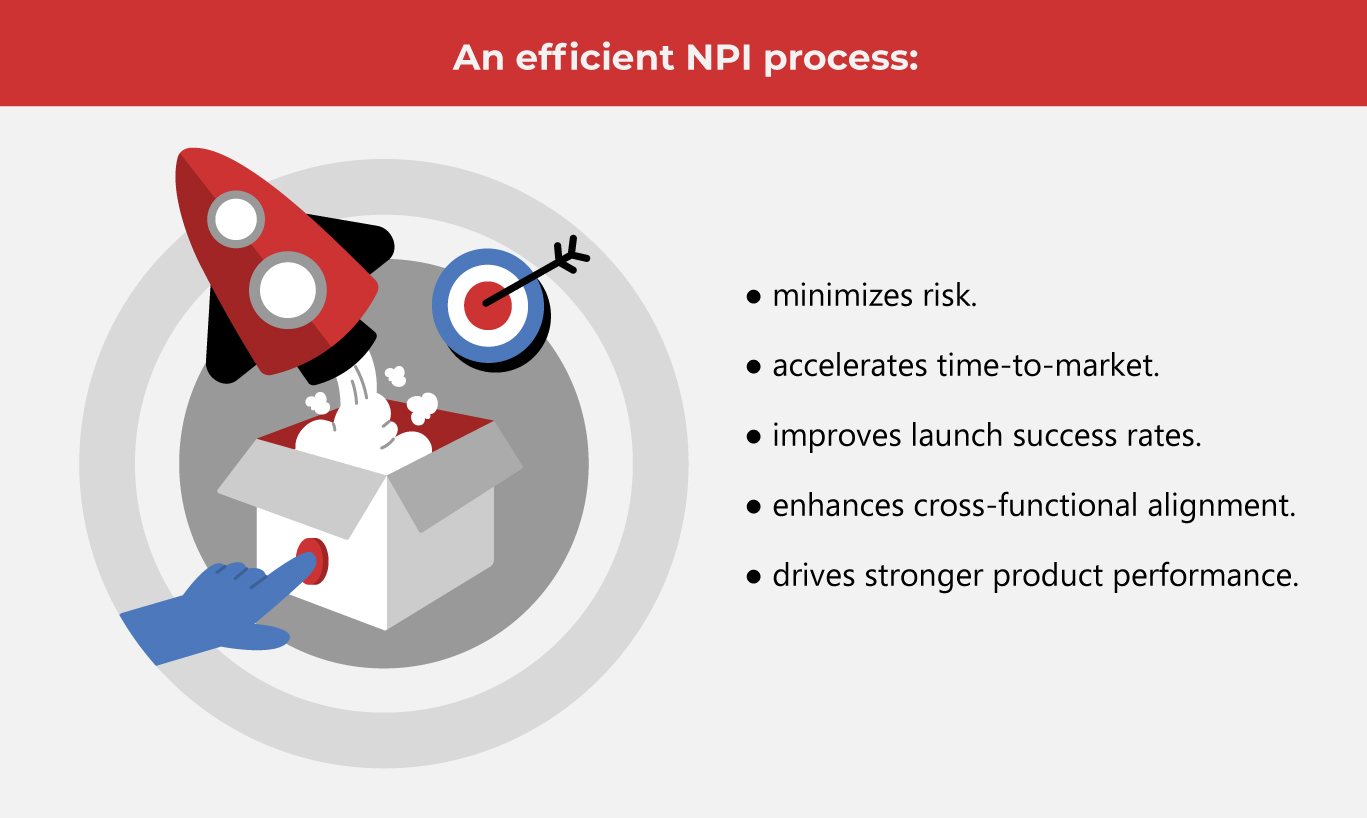
NPI Planning & Readiness
Strong planning in NPI ensures teams are better aligned and ready for each stage ahead.
-
Establish clear requirements.
Stakeholders align early by identifying and negotiating key constraints to ensure a shared understanding of project goals. Customer requirements remain the priority and must be clearly communicated to prevent misinterpretation. A structured, multi-faceted approach to requirement alignment helps streamline collaboration, reducing confusion and minimizing the risk of expensive rework later.
-
Lock early input & refine features.
Early definition of product dimensions, materials, and documentation lays the groundwork for effective development. Incorporating Design for Excellence (DFX) insights from suppliers and internal teams during alpha or beta stages strengthens validation. These testing solutions embed quality into the design early, lowering performance risks.
-
Ensure alignment between teams.
Clear communication and structured decision-making keep NPI teams aligned from concept to launch. Regular check-ins maintain coordination across functions, ensuring issues are surfaced early and addressed quickly. Supported by data-driven insights, each stage of the process focuses on the most critical design and manufacturing priorities, improving consistency and execution efficiency.
-
Target sustainability.
Long-term resilience in production depends on a well-structured supply chain strategy that supports stability and sustainability. Establishing dependable sources for raw materials helps reduce disruption risks, while adopting efficient manufacturing practices lowers waste and energy use. At the same time, careful planning for scalability and global logistics ensures operations can grow.
-
Apply data-driven insights.
Real-time production data enables continuous optimization of manufacturing processes, highlighting inefficiencies and improvement opportunities as they emerge. At the same time, quality and performance feedback support ongoing design refinements, ensuring products evolve with user needs.
Strengthening Product Lifecycle Management (PLM)
PLM is a system that manages a product’s data, processes, and collaboration from concept through design, manufacturing, and end-of-life. It helps organizations streamline product development, improve supply network responsiveness, strengthen cross-functional collaboration, and reduce time spent on low-value tasks.
Industry studies highlight persistent challenges. A key issue is organizational fragmentation, where teams rely on disconnected tools such as email and isolated file systems. This creates silos, inconsistent data, and inefficient coordination across engineering, manufacturing, and supply chain functions.
PLM solves this by centralizing product data, workflows, and collaboration into a single, connected system. With one source of truth, teams gain better visibility, fewer errors, and faster decision-making. This leads to improved efficiency, reduced development costs, faster time-to-market, and stronger commercial outcomes.
Beyond integration, PLM improves development agility by enabling better early-stage decisions, such as material selection and sourcing strategies, which significantly influence cost and performance outcomes. It also enhances collaboration by reducing time wasted searching for data and improving access to accurate, real-time information. Cross-functional teams can identify issues earlier, reducing costly late-stage changes. In addition, automation streamlines repetitive tasks like material validation and drawing updates, allowing engineers to focus more on innovation.
By integrating PLM principles into NPI, companies can minimize delays, increase the likelihood of successful launches, and enable a more seamless shift from early concept development to full-scale production.
Turning Complexity into Repeatable Success
As products become more advanced and global supply networks grow more interconnected, success depends on how well organizations can coordinate information, people, and processes in real time. NPI provides that backbone, ensuring lessons learned are captured and improvements continuously flow back into future programs. In doing so, it strengthens both execution discipline and long-term innovation capability, allowing companies to deliver better products with greater confidence at scale. As one of the Top 30 EMS companies in the world, IMI has over 40 years of experience in providing electronics manufacturing and technology solutions.
We are ready to support your business on a global scale.
Our proven technical expertise, worldwide reach, and vast experience in high-growth and emerging markets make us the ideal global manufacturing solutions partner.
Let's work together to build our future today.
Other Blog