Securing Your Supply Chain This 2026
Prior to the COVID-19 pandemic, executive leadership at small and midsize businesses often relegated logistics to the warehouse floor, focusing primarily on monthly procurement costs and localized delays. This era of passive supply chain management ended abruptly as global shortages transformed back-office operations into a critical C-suite priority. Today, the strategic oversight of supplier networks is no longer an afterthought but a fundamental requirement for maintaining market share.
Small and medium-sized enterprises now face a precarious reality, representing 90% of global businesses yet frequently lacking the capital to withstand systemic shocks. Without enhanced visibility and infrastructure, these firms struggle to improve operational efficiency and align with modern industrial demands.
(Also read: Ways to Bounce Back from Global Supply Chain Challenges)
8 Critical Supply Chain Vulnerabilities
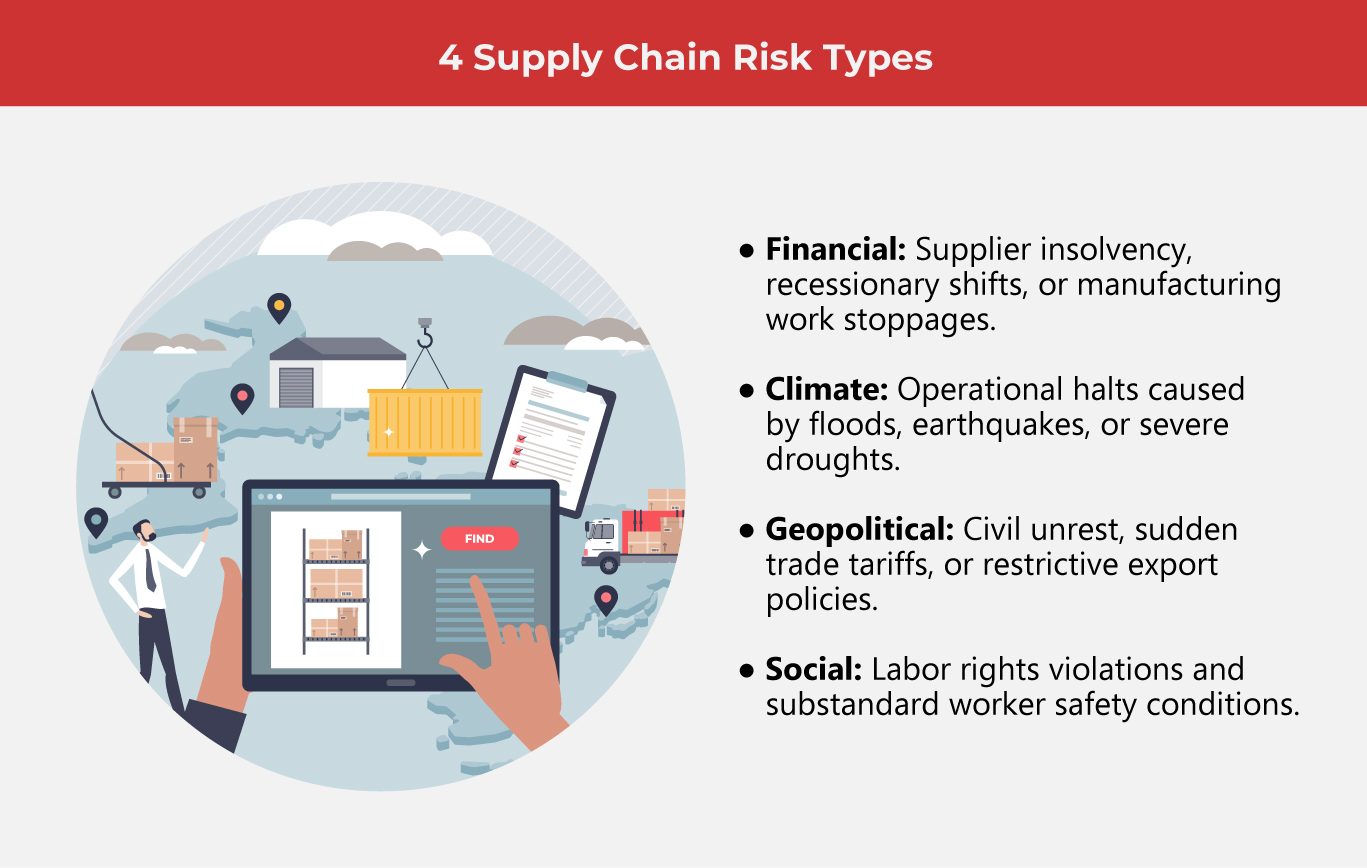
Various supply chain challenges transform minor logistical delays into systemic bottlenecks that threaten every layer of production. Securing these networks is a strategic mandate to protect margins and ensure the long-term reliability of industrial solutions.
-
Resource scarcity
High-tech manufacturing technologies and industries often rely on specialized components, such as semiconductors, that face significant sourcing hurdles. If essential production hubs experience power grid failures or logistical shutdowns, the resulting supply constraints can stall entire global networks. Companies must diversify their sourcing strategies to navigate these resource deficits without compromising delivery timelines.
-
Financial pressures
Shifting market pressures and fiscal instability frequently compromise a firm's bottom line by inflating procurement and distribution expenses. When fuel and overhead costs surge, maintaining economic value requires a proactive overhaul of existing logistics frameworks. Organizations must cultivate adaptable strategies to navigate these financial headwinds, ensuring long-term stability despite unpredictable inflationary trends and global volatility.
Digital integration boosts visibility but expands the attack surface, turning every node into a potential breach point. Incidents surged 431% from 2021 to 2023, signaling a permanent shift in the threat landscape. Organizations must fortify defenses and employee awareness to protect operations from sophisticated incursions, ensuring the long-term safety of critical assets and sensitive information.
-
Regulatory alignment
Regulatory pressures across the industrial market now encompass everything from data privacy to environmental safeguards. Overlooking these shifting mandates invites severe litigation and reputational erosion. The recent EU Corporate Sustainability Due Diligence Directive (CSDDD) exemplifies this complexity, requiring rigorous oversight of global value chains to ensure human rights and climate target alignment.
-
Demand fluctuations
Predictive uncertainty is escalating as erratic consumer patterns and sudden global shifts redefine the news about the manufacturing industry. While viral trends can spark overnight demand surges, geopolitical factors like new trade tariffs often trigger sharp market contractions. To remain resilient, firms must prioritize agility, adapting production cycles to navigate both windfall opportunities and sudden slumps.
-
Natural catastrophes
Extreme weather events frequently destabilize logistics, forcing a radical rethink of procurement and distribution. Enhancing supplier quality management now requires integrating climate-resilient sourcing and diversified shipping routes to mitigate geophysical shocks. By adopting sustainable technologies, firms not only meet regulatory mandates but also build the operational flexibility necessary to withstand increasingly frequent environmental calamities.
-
Corporate image gaps
Modern corporate success depends on maintaining transparent sustainability standards across global operations. As information travels instantly, any perceived lapse in ecological stewardship or ethical sourcing can trigger immediate brand erosion. Firms must prioritize environmental integrity and carbon-conscious procurement to satisfy intense stakeholder scrutiny, safeguarding their social license while building long-term resilience against public backlash.
-
Workforce scarcity
The widening skills gap presents a significant hurdle for organizations integrating advanced automation and AI. As traditional roles evolve, securing technical expertise for cloud-based platforms is essential to remain future-ready. By redefining training priorities and aligning workforce development with emerging digital tools, businesses can overcome current human capital deficits and build more resilient, tech-driven operations.
Boosting Your Supply Chain
To ensure long-term operational continuity, businesses must modernize their logistics frameworks and address emerging digital vulnerabilities.
-
Harness data intelligence.
Modernizing supply chain resilience requires optimizing data intelligence by integrating real-time operational and environmental metrics. Organizations must move beyond surface-level oversight, conducting a thorough analysis of end-to-end workflows—from raw material extraction to final delivery. By mapping every node and logistics link, leaders can identify hidden vulnerabilities and evaluate their true level of systemic control. This rigorous audit ensures that every procurement and distribution decision is grounded in accurate, up-to-the-minute business context and verified information integrity.
-
Maximize digitalization.
Transitioning to automated inventory controls allows organizations to shift from reactive reporting toward active strategic oversight. By centralizing stock data, companies resolve the persistent tension between shortages and surpluses through high-precision modeling. These advanced digital metrics support the expertise of procurement leads, providing the visibility required to adjust logistics chains instantly. This methodical approach ensures that every choice, from sourcing to final delivery, is grounded in verified, up-to-the-minute business context and improved operational oversight.
-
Expand the logistics ecosystem.
Broadening the procurement network allows organizations to maintain high-level agility by cultivating strategic partnerships across diverse regions. This logistics ecosystem development ensures that firms can transition between vendors seamlessly when faced with localized disruptions or shifting market requirements. By synchronizing financial management with real-time operational planning, businesses create a unified command structure. This deep supplier integration, combined with automated resource allocation, provides the structural integrity needed to navigate global volatility and maintain continuity across the entire value chain.
-
Assemble high-performance teams.
Building competent teams requires a strategic alignment between human capital and digital integration. Organizations must identify existing competency gaps early, leveraging HR partnerships to facilitate targeted upskilling or specialized recruitment. By incorporating AI-augmented workflows and agentic assistants, firms can accelerate the transition for current personnel, bridging technical knowledge divides instantly. This robust change management approach ensures that workforce architecture evolves alongside new technologies, creating a resilient operational structure capable of navigating the complexities of modern supply chain transformations.
-
Evaluate nearshoring potential.
Prioritizing regional sourcing has become a strategic imperative as geopolitical and environmental volatility challenge traditional outsourcing models. While global cost disparities historically favored distant manufacturing, the integration of smart technologies now makes localized production increasingly feasible. Utilizing IoT-driven optimization and 3D printing allows firms to minimize waste and manage virtual inventories, narrowing the margin between domestic and overseas expenses. These innovations, combined with flexible manufacturing networks, provide a buffer against systemic disruptions, ensuring long-term operational continuity.
(Also read: Improve Your Supply Chain with AI)
Securing the Global Value Chain
The transition to high-visibility logistics represents a fundamental shift in corporate strategy. By prioritizing localized sourcing and real-time data integration, organizations can insulate their production cycles from external volatility. Success in this new era depends on bridging the technical skills gap and deploying automated tools to maintain constant operational awareness.
This comprehensive modernization ensures that manufacturing networks remain agile, allowing leaders to navigate geopolitical risks while delivering consistent value in an increasingly unpredictable global market. As one of the Top 30 EMS companies in the world, IMI has over 40 years of experience in providing electronics manufacturing and technology solutions.
We are ready to support your business on a global scale.
Our proven technical expertise, worldwide reach, and vast experience in high-growth and emerging markets make us the ideal global manufacturing solutions partner.
Let's work together to build our future today.
Other Blog