Why You Should Prioritize Multi-Sourcing in 2026
Policy shifts and changing market dynamics are reshaping global electronics supply chains, introducing new pressures while redefining how the industry operates and competes.
Shorter design cycles are intensifying pressure across the industrial market, particularly within manufacturing industries where procurement and supply chain coordination must keep pace with rapid product turnover. When suppliers fail to match accelerated timelines, delays, cost overruns, and material waste follow.
Limited network visibility further heightens risk, leaving companies vulnerable to missed launch windows for high-demand products such as smartphones, laptops, and advanced printed circuit boards.
At the same time, policy is emerging as a defining force in how manufacturing industries structure sourcing strategies. In the US, the CHIPS and Science Act has driven major investment in domestic semiconductor production, with incentives supporting and unlocking planned private capital across states.
Parallel efforts in Europe and East Asia are reinforcing a shift toward regionalized supply networks, reshaping the industrial market as semiconductor access, pricing, and lead times become increasingly tied to where fabrication capacity is built.
What a Future-Ready Supply Chain Looks Like
As production networks grow more complex, strengthening manufacturing capabilities is essential, with new tools and strategies helping secure resilience and visibility.
-
AI chips in supply forecasting
AI chips and next-generation processors enable real-time forecasting and disruption detection using machine learning and digital twins. They improve demand accuracy, optimize inventory, and support faster semiconductor planning across production networks.
-
Predictive analytics for efficiency
Predictive analytics improves operational efficiency by identifying component risks early and modelling supply conditions in real time. Analyzing large datasets across materials and logistics enhances forecasting accuracy and reduces disruption-related delays.
-
Data security
As systems become more connected, cyber risk increases, particularly from third-party access. Security is strengthened through strict access controls, encryption, and continuous monitoring to ensure rapid detection and response to threats.
-
Network-wide coordination
Centralized platforms link suppliers, distributors, and OEMs through shared systems that improve visibility and coordination. Cloud-based manufacturing solutions support early design and procurement alignment, helping optimize costs and ensure compliance.
-
Live data integration
Real-time data integration enables faster decision-making by connecting pricing, lead times, and product lifecycle information across systems. Interoperability ensures seamless information flow between platforms, reducing delays and supply disruptions.
-
Sustainability
Sustainability is now integral to electronics production as stakeholders demand greater accountability for environmental factors. Circular models recover materials from e-waste, greener logistics reduce emissions, and ESG standards increasingly shape design, sourcing, and end-of-life processes.
(Also read: Securing Your Supply Chain This 2026)
What is the China +1 Strategy?
As global supply networks become more complex amid rising geopolitical uncertainty, companies are rethinking how they outsource manufacturing. The China +1 strategy has gained traction as firms maintain production in China while expanding capacity to alternative locations.
This diversification approach does not replace China but instead balances its strong industrial base with additional hubs such as Vietnam, India, and Mexico. Its driving factors include:
-
Geopolitical uncertainty
Companies are reassessing exposure to policy uncertainty, trade restrictions, and potential disruptions in cross-border production. Heightened friction among major economies has increased the risks of concentrating production in a single country, especially for industries that depend on complex global inputs.
-
Operational agility
Overreliance on a single market creates a single point of failure, driving adoption of a China +1 strategy for greater resilience and continuity. However, building new supply bases requires time for testing and supplier quality assessment. Early, strategic diversification is essential to reduce disruption risks effectively.
-
Higher manufacturing costs in China
China’s economic expansion has driven up wages, energy prices, and regulatory requirements, eroding its former cost advantage. Still, many firms remain, attracted less by low costs, advanced infrastructure, and a deeply integrated, reliable supply chain ecosystem developed over decades of industrial growth.
-
Growing market potential
Across Asia, improving infrastructure, trade rules, and investment incentives are fostering cost-competitive manufacturing hubs that support China-based operations. However, gaps remain, particularly in logistics and customs efficiency. A “+1” strategy doesn’t remove risks but helps diversify exposure and strengthen overall supply chain resilience.
-
Logistics disruptions
The COVID-19 crisis revealed how vulnerable highly concentrated supply chains were. Lockdowns, port congestion, and shipping delays hindered output, while logistics costs surged by 300–400% in some cases. In response, firms began reducing single-source dependence, with diversification beyond China now central to strengthening adaptability and long-term reliability.
(Also read: Ways to Bounce Back from Global Supply Challenges)
Why Adopt a China +1 Strategy
As companies reassess their sourcing strategies, the advantages of adopting a China +1 approach have become increasingly clear.
-
Cost efficiency
Several alternative locations provide reduced labor costs, more affordable land, and lighter regulatory expenses. These conditions can support stronger or more stable profit margins without compromising overall product standards.
-
Faster delivery times
Nearshoring production to locations closer to key markets, such as some European firms shifting operations to Central and Eastern Europe, can reduce shipping costs, shorten delivery times, and lower transport-related environmental impact. However, the benefits still depend on the specific product category and production needs.
-
Risk reduction
Diversifying production across several countries helps firms limit the impact of region-specific shocks, including policy changes, environmental events, and geopolitical uncertainty. This wider footprint reduces dependence on any single location and helps keep operations more balanced when disruptions arise.
-
Better pricing power
A more diversified supply chain reduces dependence on any one supplier or region, strengthening bargaining leverage across pricing, delivery schedules, and payment arrangements. It also improves adaptability in production volumes, allowing companies to scale output more easily in response to shifting sales patterns and changing business environments.
-
Trade and policy adaptability
Shifting production beyond China may allow firms to sidestep higher tariff barriers and take advantage of free trade agreements. However, eligibility is not automatic, as the Rules of Origin set strict criteria for qualification. Without careful supply chain planning, companies can fail to meet these requirements and forfeit expected trade benefits.
-
Stronger brand image
Rising expectations from consumers and investors have made ethical sourcing, transparency, and sustainability essential, with ESG standards and supply chain traceability now a baseline requirement. Expanding operations across multiple regions signals accountability and planning, while also supporting long-term stability and reinforcing confidence in the brand.
-
Ongoing access to China’s advantages
China continues to lead in manufacturing capabilities, research and development capacity, and large-scale infrastructure. A China +1 approach allows companies to keep benefiting from these core strengths while reducing exposure to risk through broader geographic diversification.
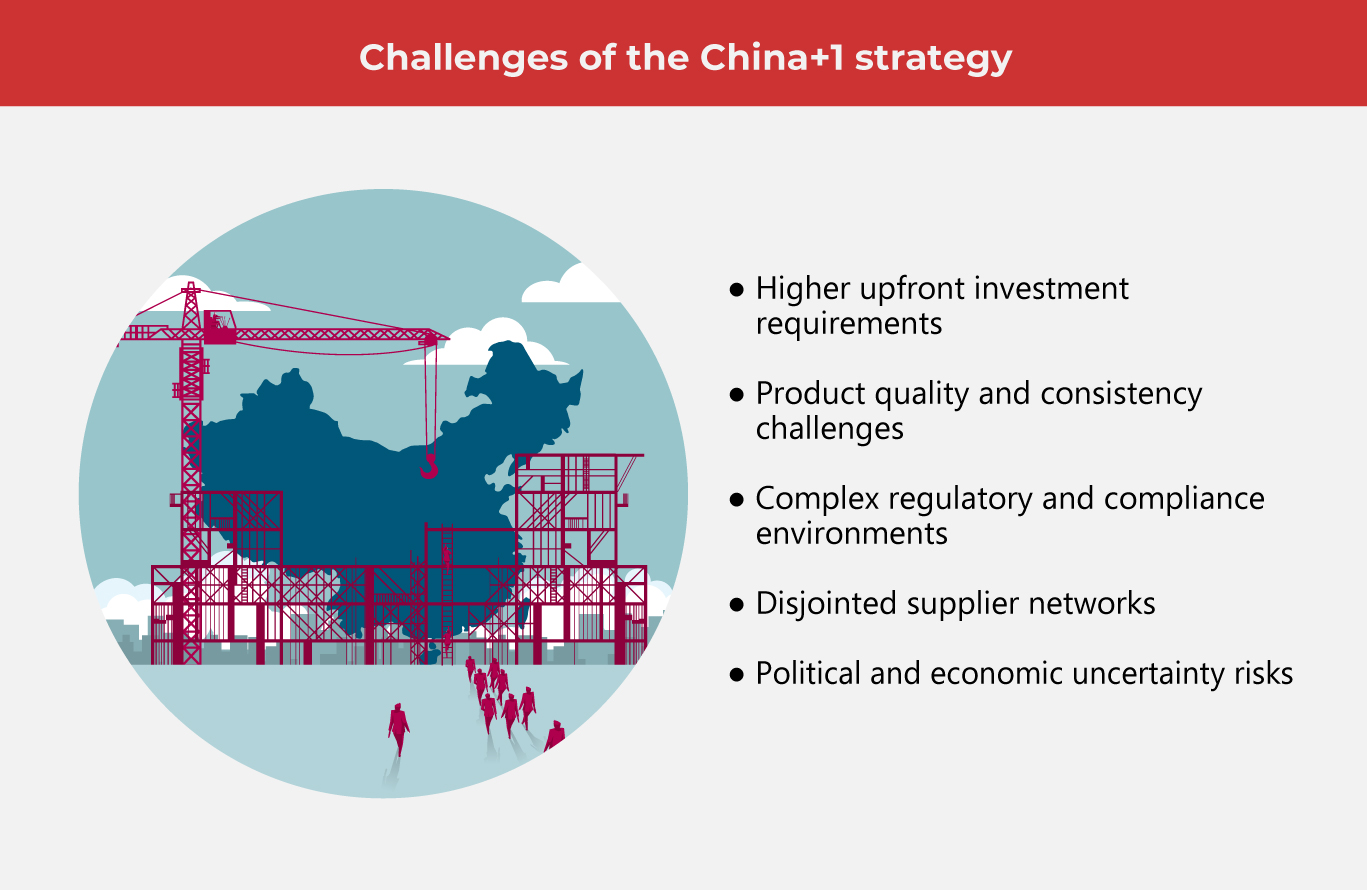
An Evolving Industrial Ecosystem
Global manufacturing is shifting due to trade uncertainty, policy changes, and ongoing supply chain vulnerabilities. Companies are moving toward more distributed and technology-enabled production models, including China +1 strategies, to improve visibility, efficiency, and risk management.
While challenges remain, companies are placing greater emphasis on adaptability, stronger coordination across partners, and sustaining uninterrupted operations within increasingly linked global production systems.
As one of the Top 30 EMS companies in the world, IMI has over 40 years of experience in providing electronics manufacturing and technology solutions.
We are ready to support your business on a global scale.
Our proven technical expertise, worldwide reach, and vast experience in high-growth and emerging markets make us the ideal global manufacturing solutions partner.
Let's work together to build our future today.
Other Blog