How Smart DFM Improves Yield and Speed
The efficient product development of electronics depends on ensuring that designs are compatible with real-world manufacturing constraints. This involves evaluating layout choices, component placement, and assembly requirements to reduce errors and improve overall reliability before fabrication begins.
While this evaluation was once carried out mainly through manual review in PCB and printed circuit board (PCBA) workflows, software-based DFM tools are now increasingly used to support and extend the process. These systems analyze complex circuit designs, flag potential production issues, and help convert design and engineering concepts into outputs that are ready for scalable manufacturing.
(Also read: How DFM Reduces Cost and Increases Profit)
10 Key Benefits of DFM Software Tools
Manufacturing industries are increasingly adopting DFM software tools to improve how electronic designs are prepared for efficient, reliable production.
-
Reduced costs
Cost is a major factor in electronics manufacturing, where design choices directly affect fabrication expenses and waste levels. Automated DFM helps identify cost drivers early by aligning layouts with material constraints, assembly requirements, and production tolerances. This reduces redesign cycles, minimizes scrap, and avoids costly manufacturing rework, ultimately lowering total production expenditure.
-
Elevated reliability standards
Beyond performance improvements, higher product reliability also carries clear economic value for businesses. Fewer defects mean reduced after-sales service requirements and lower operational risks, both of which help protect brand reputation and control long-term costs. DFM software further strengthens this by enabling early analysis and detection of potential quality issues, supporting more stable and cost-efficient product outcomes.
-
Faster product introduction
Finding issues late in the process often leads to redesign work and repeated iterations that consume time and resources, ultimately extending the product development cycle. DFM helps mitigate this by enabling engineers to anticipate potential production challenges and apply preventive adjustments early on. By streamlining this process, DFM supports a more efficient transition from design to production, shortening development timelines.
-
Quality enhancement
A large proportion of product defects, estimated at up to 80%, can be identified and addressed during the design, process planning, and product testing stages. Yet in many traditional workflows, quality control still depends heavily on manual inspection, which introduces the risk of inconsistency and human error. DFM software reduces this dependence by automatically evaluating designs against established manufacturing rules and standards, producing more consistent and data-driven assessments.
(Also read: Top Trends that Shape Automated Testing)
-
Improved operational efficiency
Design decisions made early in the development process strongly influence how efficiently a product progresses into production. DFM supports this industrial manufacturing stage by aligning product designs with material requirements and workflow constraints to streamline how components move through the system. Focusing on process optimization from the outset helps simplify production steps and improve coordination across stages.
-
Lower manufacturing risk
Industry data shows that defect rates in electronics assembly processes can range from around 0.5% to 1%, while surface-mount operations may experience yield losses of about 1.5% due to soldering issues, with higher losses occurring when process variations accumulate across production batches. DFM helps reduce these risks by shifting quality control upstream into the design phase, lowering the likelihood of defects reaching the production line, stabilizing yield, and reducing overall production risk exposure.
-
Seamless knowledge transfer
Conventional inspection approaches depend heavily on individual engineering expertise, often requiring experienced personnel to manually review designs. This creates challenges in knowledge continuity, as critical know-how can be lost or diluted when staff change or move roles. DFM software addresses this by converting expert design rules into standardized, system-driven checks that can be consistently applied across teams. By embedding this knowledge into digital tools, even less experienced engineers can achieve more reliable, expert-level assessments. This shift not only improves consistency and accuracy in design evaluation but also supports a more scalable and future-ready manufacturing workflow.
-
Product scalability
In traditional PCB/PCBA manufacturing systems, production lines are often configured for a single product type, limiting flexibility and responsiveness. Through DFM, this model can be evolved into a more adaptable test and system development environment, where multiple product variants can be supported on the same production line. This greater flexibility allows manufacturers to respond more effectively to shifts in market demand while also helping to reduce production inefficiencies and inventory-related costs.
-
Building competitive advantage
DFM builds competitive advantage by enabling faster, more reliable, and more cost-efficient product development, allowing companies to bring higher-quality products to market with greater consistency and adaptability. Beyond operational gains, the adoption of advanced DFM tools also signals strong technological maturity, which is increasingly valued by skilled professionals when choosing employers. As a result, companies that invest in DFM are better positioned to attract and retain top engineering talent, giving them access to a deeper and more capable talent pool.
-
Sustainable manufacturing practices
DFM encourages greener manufacturing practices by integrating environmental factors into the earliest phases. Optimizing layouts, material selection, and manufacturability from the outset helps reduce unnecessary material usage, minimize scrap, and lower overall resource consumption during production. This leads to less waste generated across the manufacturing cycle and supports more efficient use of inputs such as raw materials and energy. As a result, companies can align product development with broader sustainability goals while maintaining efficient and controlled production processes.
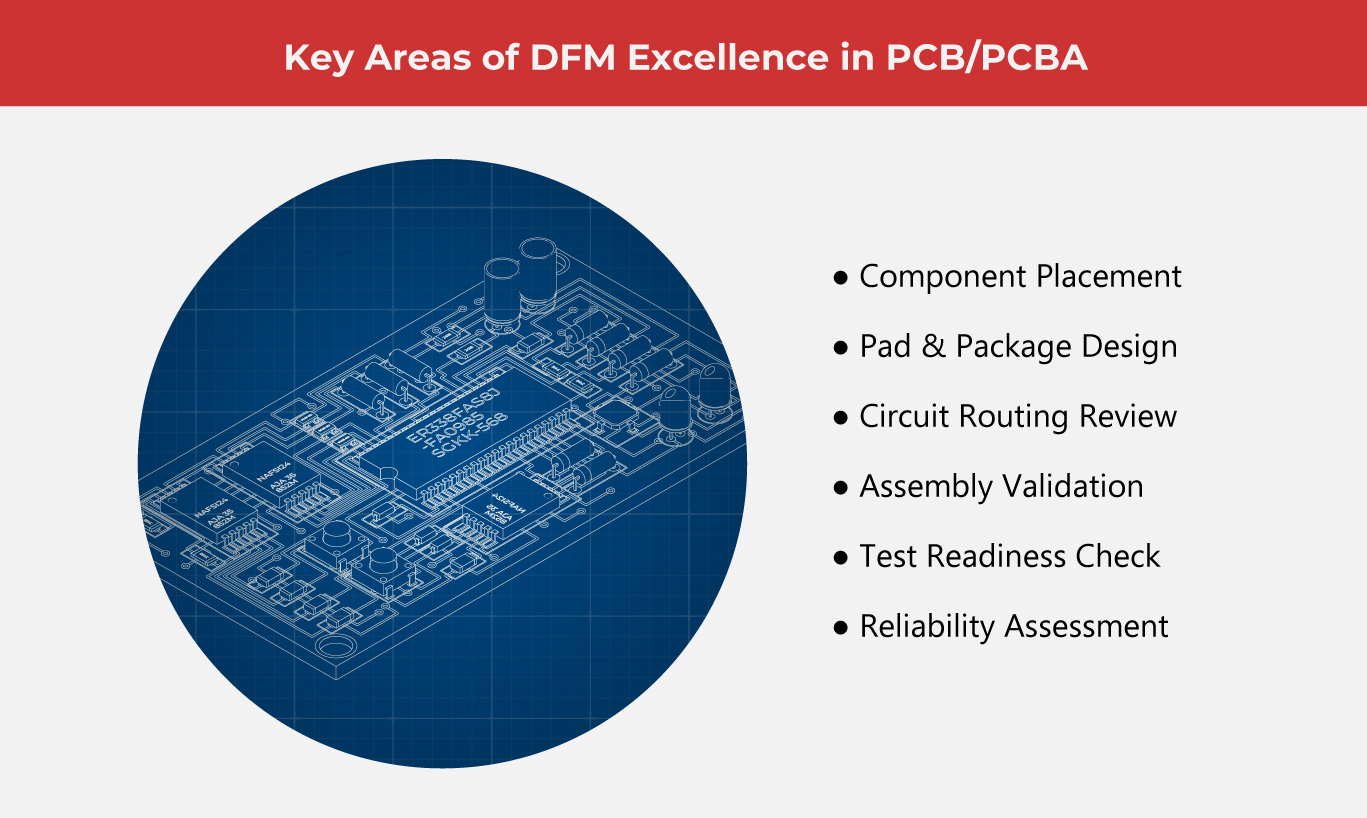
Autonomy, Intelligence, and the Future of Industrial DFM
As industrial systems evolve, automation and intelligence are increasingly embedded into both operations and design processes rather than functioning as separate layers. Automated DFM tools are enabling continuous evaluation of product designs against production constraints, allowing issues related to manufacturability, cost, and reliability to be addressed in real time as designs develop. This shifts engineering from reactive correction to continuous optimization across the product lifecycle.
Across modern industrial environments, value is now defined by long-term resilience, consistency, and reduced risk rather than output alone. By combining DFM systems with data-driven infrastructure and domain expertise, organizations can create self-improving design-to-production workflows that learn from past iterations and improve future outcomes. As one of the Top 30 EMS companies in the world, IMI has over 40 years of experience in providing electronics manufacturing and technology solutions.
We are ready to support your business on a global scale.
Our proven technical expertise, worldwide reach, and vast experience in high-growth and emerging markets make us the ideal global manufacturing solutions partner.
Let's work together to build our future today.
Other Blog