What Is GPON Know Why It Matters
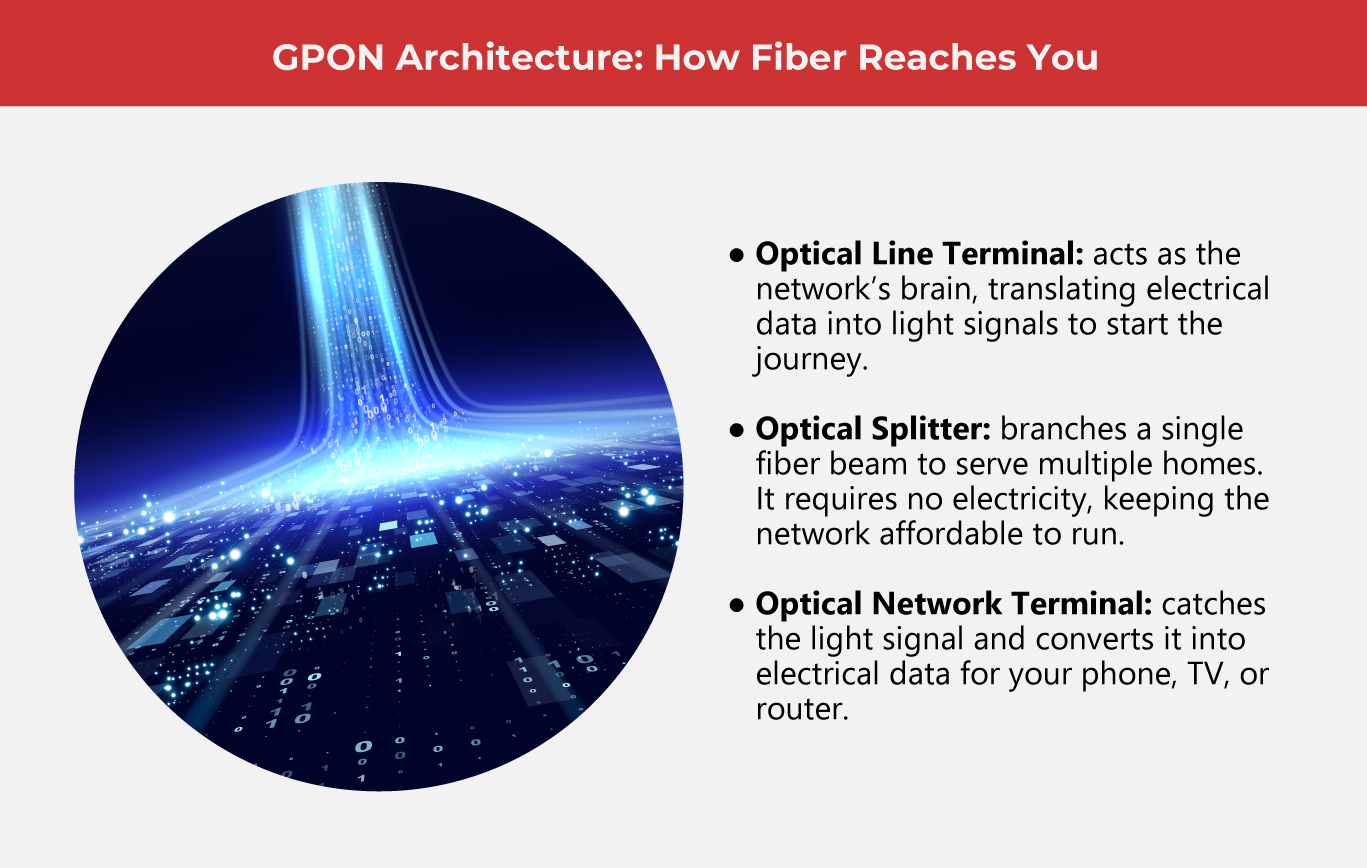
The shift toward digital transformation, driven by the rise of smart cities, IIoT, and 5G, has made high-capacity infrastructure a business necessity. At the heart of this evolution is Gigabit Passive Optical Network (GPON) technology. Originally designed to streamline services like data, voice, and video, GPON has matured into a cornerstone of modern connectivity. Its brilliance lies in a point-to-multipoint architecture that utilizes unpowered, passive optical splitters. This design significantly reduces the amount of physical fiber and active electronic equipment needed between a central office and its endpoints.
For telecommunications providers and enterprises, the primary appeal of GPON is its ability to improve operational efficiency. By eliminating the need for powered components in the field, organizations reduce both energy consumption and the long-term maintenance costs associated with traditional active networks. This streamlined approach offers immense economic value, allowing ISPs to scale their fiber-to-the-home (FTTH) deployments rapidly while maintaining high-security standards through advanced encryption.
Beyond residential use, GPON is increasingly integrated into complex industrial solutions and enterprise environments. With impressive downstream speeds of up to 2.4 Gbps and a reach of 20km without signal loss, it provides a stable foundation for high-demand applications. As the industry moves toward even more data-intensive services, GPON remains the dominant standard for delivering reliable, cost-effective, and scalable broadband to a global market.
(Also read: Top Network API Trends Shaping 2026)
The GPON Edge
As high-speed connectivity becomes essential, GPON offers the industrial market a scalable, value-driven fiber solution that delivers gigabit performance with minimal infrastructure complexity.
-
High-speed connectivity
GPON delivers massive throughput, supporting seamless 4K streaming and lag-free conferencing. Unlike interference-prone copper, fiber optics transmits data across longer distances with minimal maintenance. By prioritizing critical traffic through smart service management, it provides a stable, multi-service platform that is now a fundamental pillar within the telecommunications sector.
-
Economical advantage
Harnessing the power of light, GPON transforms connectivity by linking dozens of homes through a single fiber strand. This unpowered, splitter-based architecture minimizes hardware needs and slashes energy use, embedding sustainability into every connection. It is a lean, high-capacity solution for developers seeking to provide expansive, reliable broadband while maintaining a smaller ecological footprint.
-
Protected stability
Beyond its speed, GPON acts as a digital fortress. Its fiber architecture is naturally immune to electromagnetic disruption, ensuring steadfast connectivity in any environment. Robust encryption protocols safeguard every byte, while centralized monitoring allows for real-time performance analysis. This combination of physical resilience and sophisticated data protection makes it a trusted standard for high-stakes enterprise communications.
-
Scalability
GPON serves as a dynamic foundation, offering an expansive highway for data that effortlessly adapts to growing traffic. Its inherent flexibility allows operators to transition toward even faster technologies without costly overhauls. This strategic approach to product development ensures that today’s fiber investments remain relevant, scaling seamlessly to meet the shifting connectivity needs of any community.
-
Green viability
GPON reduces environmental impact by using passive optical splitters that require no electricity between the provider and the user. This unpowered architecture slashes energy consumption and minimizes the need for cooling and bulky hardware. By streamlining infrastructure, it offers a high-capacity, low-carbon alternative to traditional networks, fostering long-term ecological stewardship.
(Also read: This Small but Powerful Smart Power Module Is Making Waves)
Diverse Industrial Applications of GPON
Beyond its origins in residential broadband, GPON has evolved into a versatile backbone for modern infrastructure. This efficiency is increasingly vital for the renewable energy market, where remote monitoring of solar and wind farms requires low-power, high-reliability data transmission over vast distances.
The technology’s impact is equally profound in specialized sectors like healthcare. Within hospitals, GPON supports the high-bandwidth demands of medical electronics, facilitating real-time diagnostic imaging and seamless telemedicine. Its immunity to electromagnetic interference ensures that sensitive life-support systems and monitoring tools remain stable, providing a secure environment where data integrity is never compromised.
In high-density environments, such as luxury resorts and multi-dwelling units, GPON replaces bulky copper with a single, streamlined fiber. Because the network is passive, it requires significantly less cooling and maintenance, allowing property managers to scale their connectivity without a corresponding spike in operational costs.
Looking toward urban innovation, the automotive market is beginning to mirror these network architectures to handle the massive data flow required for smart city integration and autonomous vehicle communication. GPON provides the scalable, high-throughput foundation needed for public Wi-Fi and surveillance systems that keep these ecosystems connected.
Ultimately, GPON represents more than just a faster internet connection; it is a future-proof investment. From optimizing energy grids to powering digital classrooms, GPON delivers the agile, high-performance connectivity necessary to drive global progress in a data-driven age.
The Next Frontier of GPON
The evolution of GPON technology marks a pivotal shift toward a more intelligent, high-capacity digital ecosystem. The industry is rapidly moving beyond standard gigabit limits, with 10-Gigabit-capable Symmetric Passive Optical Network (XGS-PON) becoming the benchmark for symmetrical 10 Gbps services and Next-Generation Passive Optical Network 2 (NG-PON2) paving the way for multi-wavelength, 40 Gbps+ performance. These advancements are not merely about speed; they are the essential backhaul for 5G networks, providing the low-latency infrastructure required for edge computing and real-time automation.
A major trend is the integration of Software-Defined Networking (SDN) and Network Functions Virtualization (NFV), which transitions network management from rigid hardware to flexible, software-driven platforms. This virtualization enables operators to automate traffic flow across the Wide Area Network (WAN) and deploy "network slicing," where specific bandwidth can be dedicated to critical services like telemedicine or autonomous driving. Additionally, innovations in higher split ratios allow a single Optical Line Terminal (OLT) port to serve more users, significantly lowering the barrier for global broadband expansion.
As the telecommunications sector converges with AI and cloud-native technologies, GPON's future lies in its role as a "value center." By combining massive throughput with sophisticated analysis and unpowered, green components, it ensures that fiber investments remain resilient, scalable, and capable of supporting the next decade of digital innovation.
 As one of the Top 30 EMS companies in the world, IMI has over 40 years of experience in providing electronics manufacturing and technology solutions.
We are ready to support your business on a global scale.
Our proven technical expertise, worldwide reach, and vast experience in high-growth and emerging markets make us the ideal global manufacturing solutions partner.
Let's work together to build our future today.
Other Blog