Are We Ready for 6G?

6G represents the next stage of wireless communication, expected to succeed today’s 5G networks. While 5G remains the dominant global standard, product design and development into sixth-generation technology is already accelerating, with increasing attention from industrial markets and governments. Early concepts suggest 6G will deliver dramatically higher speeds, leveraging advanced cloud-based systems and the use of higher-frequency spectrum to support more data-intensive applications.
Still in the test and system development phase, 6G builds on the foundations laid by 4G and 5G, aiming to push connectivity into a new era of performance and capability. Although it does not yet exist as a commercial technology, it is widely seen as the next major leap in mobile communications. As global interest intensifies and early groundwork continues, 6G is steadily moving from theoretical research toward future deployment, raising questions about how soon it will become reality and how profoundly it could reshape digital connectivity.
(Also read: Telco Testing Gets a Boost from AI)
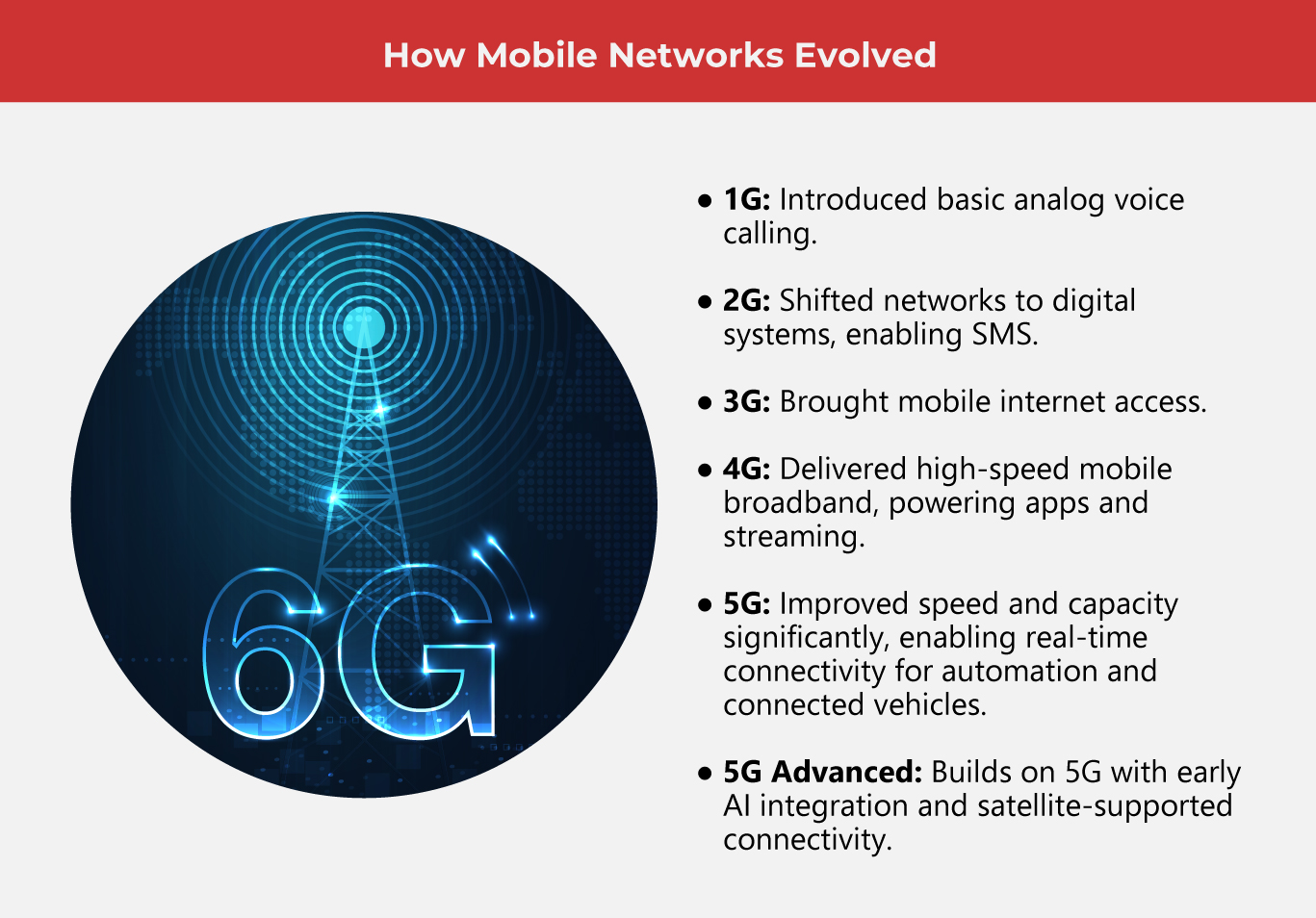 Like previous mobile generations, 6G will be defined through technical standards developed by the 3rd Generation Partnership Project (3GPP), the international body responsible for creating mobile network specifications. Standardization work is already progressing through structured phases.
At the global level, these specifications are being developed to align with the International Telecommunication Union's International Mobile Telecommunications 2030 (IMT-2030) framework, which establishes the vision and performance requirements for the next generation of mobile networks and helps coordinate worldwide deployment.
The first full set of 6G specifications is expected to be completed around 2029 to 2030, marking the foundation for commercial deployment. Key technical decisions and timelines for detailed specification work are expected to be confirmed in 2026, serving as an important checkpoint for evaluating candidate technologies under the radio access network (RAN) and system architecture groups.
Radio spectrum is essential for wireless communication, as it carries the signals that power mobile networks. As 6G takes shape, spectrum planning has become a joint effort involving governments, regulatory authorities, and the mobile communications sector to allocate frequencies for next-generation services. This is happening at both national and regional levels, as well as through international coordination. Aligning these choices globally is important because harmonized spectrum allows networks to improve operational efficiency across borders, boost economic value, and support better device compatibility.
Commercial 6G services are expected around 2030, marking a new step in mobile connectivity. In the United States, early demonstrations are planned for the 2028 Los Angeles Olympics, led by the National Telecommunications and Information Administration (NTIA) to showcase emerging capabilities.
What 6G Brings to the Table
6G serves as a product introduction that highlights the key benefits and potential of next-generation connectivity.
-
AI-driven intelligence
6G is expected to embed AI across network design, operations, and user experience, enabling smarter management and advanced capabilities like digital twins, machine communication, and immersive applications within an intelligent, highly connected network ecosystem.
(Also read: IoT Evolves into Smarter, Faster Connected Systems)
-
Ultra-fast data speeds
Expected to far surpass 5G, 6G could deliver data speeds up to 100 times faster, enabling near-instant downloads, smoother streaming, and virtually lag-free communication. Such performance may also unlock other applications once considered beyond today's technological reach.
-
Expanded spectrum capacity
Through ongoing product testing, 6G is expected to use new 7–16 GHz and 100+ GHz spectrum bands alongside existing frequencies. This expands coverage, increases network capacity, and enables smoother integration with satellite communications for more consistent wireless performance.
-
Designed to scale
6G introduces more flexible network systems, thanks to advanced design and engineering. It uses disaggregation, cloud-native technologies, and a simplified control layer to reduce complexity while enhancing adaptability and overall performance.
-
Sensing-enabled network
A new generation of wireless systems is expected to integrate communication and sensing into a single framework, enabling networks to detect objects, movement, and gestures without requiring any devices on the target.
-
Connectivity without boundaries
6G is expected to merge ground-based and non-terrestrial networks from the beginning, forming a unified infrastructure that delivers seamless, reliable connectivity across diverse and remote environments, extending coverage beyond traditional limits.
-
Stronger communication
Future 6G systems are expected to introduce advanced technologies that improve connection reliability across diverse conditions. With better mobility support and improved interference control, networks will deliver more stable and consistent communication in increasingly complex environments.
Expanding 6G Use Cases
6G is expected to drive major advances, enabling entirely new categories of devices, services, and network deployments. By embedding intelligent computing throughout the network, it will extend both fixed and mobile broadband into truly pervasive systems that support spatial awareness and real-time control. This shift is expected to enable highly advanced use cases such as holographic communication, collaborative robotics, human augmentation, and deeper immersion within virtual and extended reality environments.
Building on capabilities introduced in 5G Advanced, 6G is expected to further refine technologies such as machine learning integration across radio access and core networks, ultra-low latency performance, improved energy efficiency, advanced multiple-input multiple-output (MIMO) techniques, and tighter satellite integration. It will also expand integrated sensing and communication functions, which are increasingly viewed as a core feature of future networks.
Beyond technical upgrades, 6G is expected to extend mobile technology into critical sectors such as medical electronics, agriculture, and the automotive market. This broader application will support more seamless, always-available digital services.
Shaping the Next Digital Frontier
6G is not simply the next upgrade in mobile technology, but a shift toward networks that act more like intelligent systems than communication tools. As development moves closer to global standards and eventual rollout around 2030, attention is turning to how these networks will quietly embed themselves into infrastructure, industries, and everyday environments.
The focus is increasingly shifting from what 6G will enable to how it will be governed, secured, and integrated at scale. Its real impact may not be defined by speed alone, but by how seamlessly it supports automation, sensing, and decision-making across physical and digital worlds.
As one of the Top 30 EMS companies in the world, IMI has over 40 years of experience in providing electronics manufacturing and technology solutions.
We are ready to support your business on a global scale.
Our proven technical expertise, worldwide reach, and vast experience in high-growth and emerging markets make us the ideal global manufacturing solutions partner.
Let's work together to build our future today.
Other Blog