Scale Smarter How AI and RPA Drive Business Growth
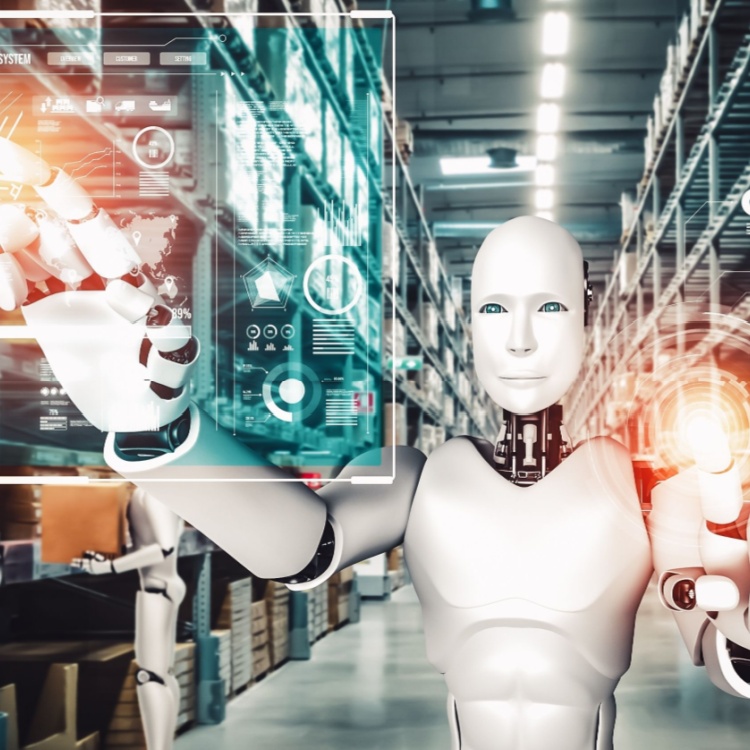
Today’s businesses are increasingly adopting RPA to transform their internal workflows. This software technology utilizes bots, which are programs designed to mimic human actions, to standardize and automate repetitive, rule-based business tasks. By navigating user interfaces to handle data entry, extraction, and form filling, RPA offloads mundane activities from the workforce.
The maturity and non-invasive nature of these tools make them a preferred choice for system integration across diverse industries. Because RPA operates on structured data and predictable scripts, it executes high-volume processes without error. This reliability enables human employees to focus on creative, strategic work, ultimately boosting morale and engagement.
Beyond simple task automation, RPA provides a clear Return on Investment (ROI) by offering scalable testing solutions that ensure consistent performance. As companies seek to remain future-ready, investing in these robots becomes essential for maintaining a competitive edge.
(Also read: How IMI Can Improve Your Products with Testing and Calibration)
Synergizing RPA and AI
AI represents a paradigm shift in how machines simulate human intelligence through learning, reasoning, and self-correction. Unlike traditional automation, AI utilizes mathematical and logical methods to identify patterns within unstructured data, enabling it to make complex predictions and recommendations. This broad spectrum of technologies, including machine learning, natural language processing, and computer vision, allows systems to evolve by learning from errors to improve accuracy over time.
While AI does not execute workflows in isolation, it is transforming the automation landscape by addressing the rigid limitations of rule-based tools. This evolution is particularly evident when looking at news about the manufacturing industry, where AI-driven insights are now essential for maintaining a competitive edge. By integrating intelligent decision-making into the core of operations, companies can scale more effectively and even audit their own processes to prevent fraud.
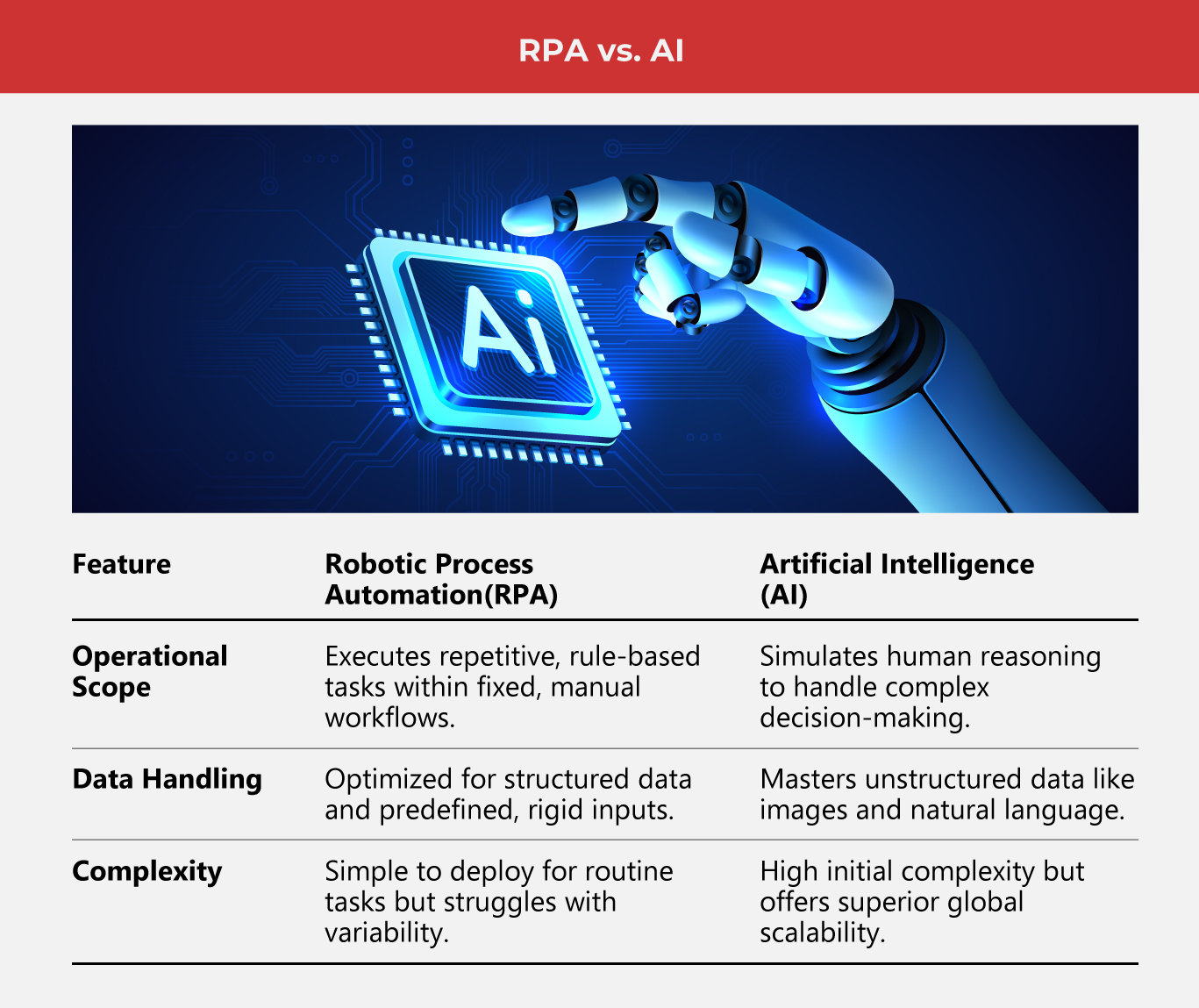
The fusion of RPA and AI creates an intelligent workforce where RPA acts as the executor and AI serves as the cognitive engine.
By integrating machine learning and decision engines, these systems transform unstructured data into actionable insights. This is particularly vital for global manufacturing, where AI-enabled robots optimize workflows and reduce errors across the supply chain. These advanced industrial solutions empower businesses to move beyond simple tasks, achieving higher productivity and superior customer satisfaction.
Here are other benefits of the AI-RPA synergy:
-
End-to-End Process Automation
While RPA handles structured, rule-based tasks, AI processes unstructured data like emails and natural language. This synergy allows for the automation of complex workflows from start to finish, moving beyond simple task execution to cognitive problem-solving within manufacturing technologies and industries.
-
Improved Decision-Making
AI provides the cognitive brain to interpret patterns, enabling robots to make informed choices rather than just following rigid scripts. This intelligence is vital for product design and development, where predictive analytics and generative models optimize resource allocation and accelerate innovation cycles.
-
Enhanced Data Accuracy
The fusion of RPA’s precision and AI’s pattern recognition provides a robust foundation for reliability testing. This ensures high-volume production remains error-free and compliant with rigorous industrial standards, significantly lowering the risk of manual errors and ensuring high-quality outputs.
-
Greater Scalability
Intelligent digital workers can handle fluctuating workloads without needing proportional increases in human staff. By fusing AI orchestration, decision engines, and machine learning models, businesses can unify end-to-end automation in a single ecosystem that scales with global demand.
-
Increased Employee Productivity
RPA acts as the doer, mimicking human actions to offload manual processes, while AI acts as the thinker. These digital workers perform without breaks, allowing human teams to pivot toward creative, strategic work, ultimately boosting morale and engagement.
-
Superior Customer Experience
Automation leads to faster response times and more personalized interactions through AI-driven insights. Capturing greater insight from unstructured content, IoT sensors, and analytics is center stage in making robots more intelligent and achieving higher customer satisfaction.
-
Cost Reduction and ROI
Often viewed as separate entities, RPA and AI are now inseparable components of a modern industrial strategy. Streamlining operations minimizes resource drain and helps businesses audit their own workflows to prevent fraud, leading to a faster and more transparent Return on Investment.
(Also read: 3 Breakthrough Ways to Train Robots)
Strategic Advantages of RPA-Driven AI
While discussions often focus on how AI enhances RPA, the relationship is a two-way street. RPA provides the structural framework and data pipeline necessary for AI to function effectively within complex global manufacturing environments. By acting as the operational hands for the cognitive brain, RPA transforms raw system activity into the structured inputs required for high-level machine learning and analysis.
-
Optimized Data Pipeline and Labeling
RPA digital workers act as the ultimate data clearinghouse. They gather, clean, and label information across disparate systems, ensuring that AI models make decisions based on accurate, contextual data. This is especially critical during product testing, where clean data sets are mandatory for identifying subtle defects.
-
Legacy System Interconnectivity
Modern AI tools often struggle to communicate with older, fragmented infrastructure. RPA bridges this technical gap, extracting data from legacy software that lacks modern Application Programming Interfaces (APIs) and feeding it directly into AI engines to ensure comprehensive analysis across the entire enterprise.
-
Operational Transparency and Auditability
AI is often criticized for being a black box with hidden logic. RPA introduces a layer of accountability by ensuring every step in a workflow is followed systematically. This creates a clear audit trail, providing the explainability needed for regulated manufacturing standards.
-
Human-in-the-Loop Governance
RPA serves as a vital safety net for autonomous decision-making. For instance, if generative AI produces content for a sensitive record, an RPA bot can automatically redirect that output for human verification, preventing unvetted data from entering the production cycle.
-
Continuous Performance Monitoring
Beyond execution, RPA tracks the health of AI systems. By monitoring for errors or drift in logic, bots can flag anomalies during product testing or live operations, allowing for rapid self-correction and maintaining the integrity of the AI workforce.
Harmonizing Efficiency and Oversight in Automation
Successful integration of cognitive tools and process robots requires balancing transformative power with structural discipline. While this synergy significantly boosts output and long-term scalability, organizations must address the inherent complexities of implementation. By utilizing proven architectural frameworks and unified governance platforms, businesses can mitigate risks associated with change management and compliance, ensuring that every automated workflow remains fully auditable.
Ultimately, transitioning to an intelligent digital workforce minimizes manual errors and optimizes resource allocation without inflating operational overhead. When structured planning meets advanced reasoning, the result is a resilient, adaptable infrastructure. This strategic alignment not only reduces immediate costs but also provides the high-level precision necessary for leaders to maintain a competitive advantage in a rapidly evolving market.
As one of the Top 30 EMS companies in the world, IMI has over 40 years of experience in providing electronics manufacturing and technology solutions.
We are ready to support your business on a global scale.
Our proven technical expertise, worldwide reach, and vast experience in high-growth and emerging markets make us the ideal global manufacturing solutions partner.
Let's work together to build our future today.
Other Blog